

 English
 Español
You are choosing the wall treatment for a meeting room, a hotel lobby, or a home theater media wall. The shortlist usually comes down to two names: an acoustic grille panel and a traditional acoustic panel. Because both are sold as acoustic solutions, many buyers treat them as interchangeable. They are not.
An acoustic grille panel is a finished wall cladding with a sound-absorbing backing built in. A traditional acoustic panel is a dedicated absorber that must be fixed and then designed around. So the real comparison covers installation, durability, appearance, and installed cost, not just absorption numbers.
Key takeaway: If the wall is the centerpiece of the room and echo is the problem, a grille panel solves both in one layer. If you need maximum absorption per square meter, a traditional panel remains valid.
What Are Acoustic Grille Panels and Traditional Acoustic Panels?
Acoustic grille panels, also called slat acoustic panels, WPC grille panels, or akupanel-style panels, combine three jobs in one board. The face layer is a grille or slat arrangement of WPC, PVC, or another rigid decorative material. Behind or between the slats, a polyester felt backing absorbs sound energy. The panel reflects some sound, diffuses some, absorbs some, and arrives as a finished wall surface.
Traditional acoustic panels cover a broader family: fabric-wrapped fiberglass, mineral-wool boards, foam tiles, and polyester fiber panels. These products are engineered for one purpose, absorbing sound efficiently, so their NRC ratings are typically high. The trade-off is that they are not a finished wall. They need frames, adhesives, and careful placement, or the room looks unfinished.
For projects that need both acoustics and a design statement, an interlocking WPC grille panel is usually the more complete product.
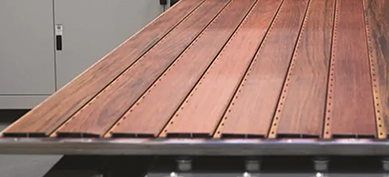
 Interlocking WPC Acoustic Grille Wall Panels for Sound and Fire ResistanceCombines acoustic absorption with full-wall covering, offering a decorative grille surface that also meets fire and sound insulation requirements. Its interlocking design simplifies installation while providing a complete wall finish.View Product →
Key Differences at a Glance
Remember one idea and the rest follows: a grille panel is a complete wall surface, while a traditional acoustic panel is an acoustic device that must be integrated into a wall.
Finish plus absorption
One board provides cladding and sound control at the same time.
Interlocking installation
Direct-to-wall assembly reduces layers, framing, and labor.
Durable materials
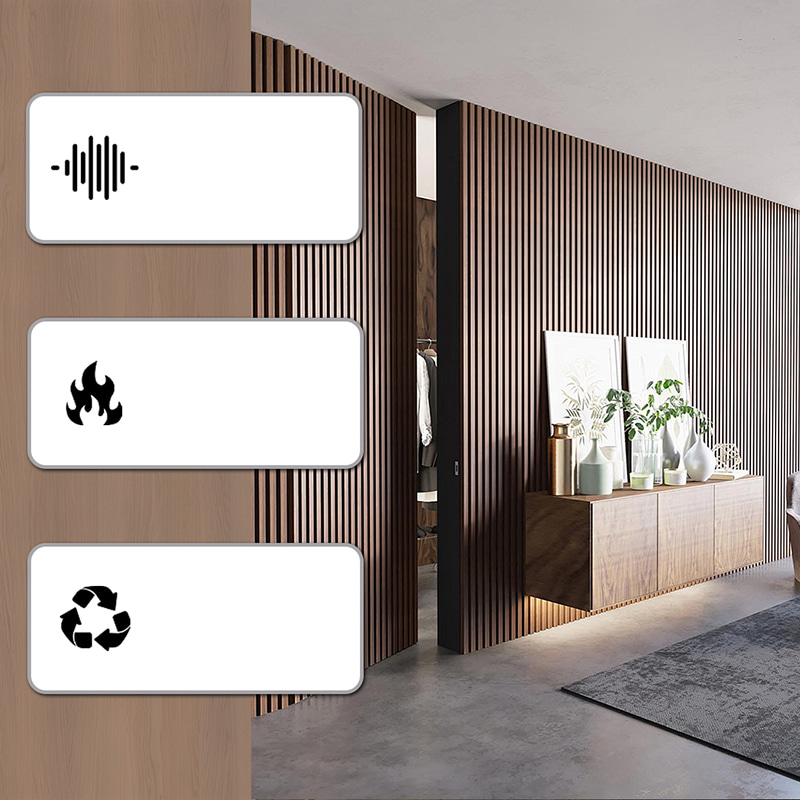
WPC and PVC grille panels offer moisture-resistant and fire-retardant options.
| Comparison Point | Acoustic Grille Panel | Traditional Acoustic Panel |
|---|---|---|
| Primary role | Decorative cladding with acoustic control | Dedicated sound absorption |
| How sound is managed | Felt backing absorbs; slat gaps diffuse | Porous core absorbs over a wide frequency range |
| Visual outcome | Pre-finished wood grain, fluted, grille, or LED design | Fabric or foam face with visible seams and frames |
| Installation | Interlocking, direct-to-wall, one layer | Framing, adhesive, and careful alignment required |
| Moisture behavior | WPC or PVC core resists damp conditions | Fiber-based cores can absorb humidity and sag |
| Fire performance | Fireproof B1 or flame-retardant options available | Depends on core material and fabric chosen |
| Maintenance | Wipeable like a normal wall panel | Vacuum only; fabric stains and can tear |
Sound Absorption Performance: Where Each One Wins
For pure absorption per square meter, a traditional acoustic panel usually wins. They absorb across a wide frequency range, which is why studios and lecture rooms rely on them.
An acoustic grille panel approaches the problem differently. Its felt backing absorbs a useful share of mid- and high-frequency sound, while the slat surface reflects part of the energy and the gaps scatter the rest. In an occupied room this mix often sounds better than dead absorption: it lowers echo and reverberation while keeping speech intelligible.
The slat-to-gap ratio in an acoustic grille panel is the main tuning control. Narrower gaps increase the effective absorbing area; wider gaps create more diffusion. Choose a layout that fits the room instead of accepting a one-size-fits-all absorber.
Coverage matters as much as the coefficient. A few high-NRC panels leave wide reflective zones between them. A grille panel wall can cover a whole feature wall and still look intentional, so its real-world result usually beats what the lab number implies.
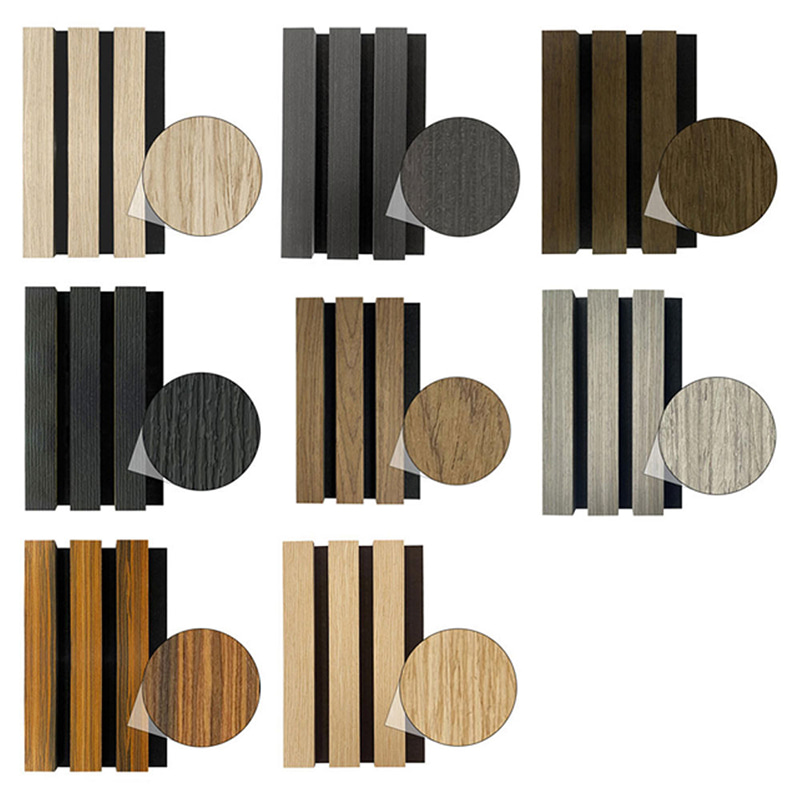
 WPC Slat Acoustic Panels with Wood Grain and Wide Color OptionsThese WPC slat panels use a slit resonance structure to absorb sound while offering a selection of wood finishes. They suit professional venues and residential interiors, balancing acoustic performance with water and insect resistance.View Product →
Aesthetics and Design Flexibility
Traditional acoustic panels are made to control sound, not to make a design statement. Fabric colors expand the palette, but the final look is still a grid of rectangles with visible seams and metal frames. In a hotel corridor or a living room, that look is a compromise.
Acoustic grille panels are manufactured as a decorative layer first. Wood-grain finishes, walnut tones, black brushed profiles, fluted textures, and even LED-integrated grille designs produce a ready-made feature wall. Slats also hide joints, so large walls feel continuous. A backlit night-sky grille panel, for instance, hides the acoustic function completely behind the visual effect.
Custom colors and profiles are common in factory-direct production, so one panel family can serve a minimalist apartment, a corporate lobby, or a restaurant. A traditional panel, by contrast, is usually ordered in fixed rectangles and then framed on site.
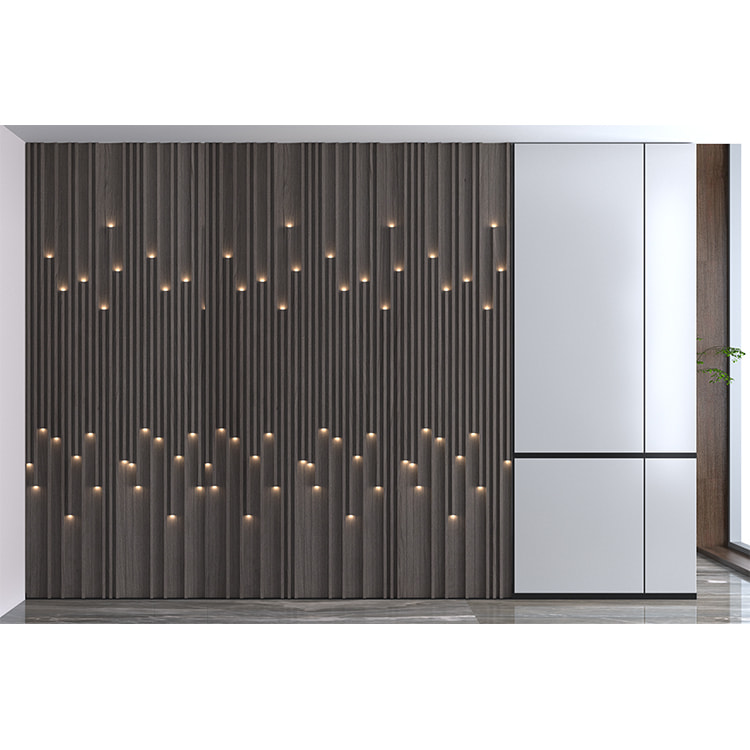 Luminous WPC Grille Wall Panels with Integrated LED LightingThese grille panels feature embedded LED lighting controlled by remote or app, creating a starry sky effect. With customizable colors and profiles, they add ambiance to residential and commercial spaces while retaining B1 fire rating.View Product →
Installation, Durability, and Maintenance
Installation shows the biggest practical difference. Traditional panels require a prepared wall, an air gap or furring grid, strong adhesive or mechanical fixing, and careful edge trimming. The work normally involves several steps: surface prep, fixing, and final finishing.
Grille panels are installed like architectural cladding. Interlocking WPC and PVC panels mount directly onto reasonably flat walls, align through the joint profile, and can be cut with standard woodworking tools. A two-person crew can sheath a large media wall in a day, cutting labor cost and downtime.
Durability also separates them. Fiber-based panels absorb humidity and can sag or stain over time. WPC and PVC grille panels resist moisture, hold their shape in damp conditions, and wipe clean like a decorative panel. Fire performance should be verified per product: many WPC acoustic panels carry fireproof B1 grade or flame-retardant claims, while traditional panels vary by core and fabric.
Cost and Buying Considerations
Comparing only the price per sheet is misleading. A low-cost traditional panel becomes expensive once you add aluminum edging, acoustic adhesive, an air-gap system, fixing labor, and a separate decorative covering. The installed cost of an acoustic grille panel is often similar, and in smaller projects it can be lower, because the material is already the final surface.
When purchasing in volume, evaluate the whole supply chain. Factory-direct supply lets you coordinate panel profiles, surface finishes, felt backing density, and export packaging in one order. Before committing, check the following:
- Fire and moisture test documentation with flame-retardant ratings.
- Felt backing density and acoustic test data for the exact panel.
- Scratch resistance and UV stability for exposed installations.
- MOQ, lead time, color matching, and availability of custom profiles.
- A physical sample so you can verify color, slat width, and joint quality.
How to Choose the Right Panel for Your Project
Start from the room, not from the label.
- Choose a traditional acoustic panel when maximum absorption per square meter is the priority, such as a studio or lecture hall, and when the contractor can build a frame-based installation correctly.
- Choose an acoustic grille panel when you want a finished wall that also controls echo: TV background walls, hotel rooms, offices, restaurants, and any area where appearance matters as much as acoustics. Grille panels are also the safer pick for bathrooms, kitchens, and humid climates.
- Compare installed cost. Add framing, adhesives, finishing, and maintenance to both options before setting a budget.
- Verify the data. NRC values, B1 fire ratings, and moisture-resistance claims should come from the manufacturer in writing.
In an office, decide whether the wall is a design element or simply a sound sink; the product choice follows.
Frequently Asked Questions
Q1: Can an acoustic grille panel replace a traditional acoustic panel?
Not as a one-for-one swap. A traditional panel absorbs more per square meter, while a grille panel provides a balanced mix of absorption, diffusion, and finished appearance. For most offices and residential feature walls, the grille panel integrates better; for studios and classrooms that need maximum absorption, the traditional panel still has a clear role.
Q2: What is the ideal slat-to-gap ratio for an acoustic grille panel?
There is no universal ratio. Narrower gaps increase effective absorption; wider gaps increase sound diffusion and reveal more felt. A balanced starting point works for most rooms; adjust to the room acoustics and check the panel data.
Q3: Are acoustic grille panels waterproof?
WPC and PVC grille panels are moisture-resistant and can be used in bathrooms, kitchens, and humid climates. The felt backing is not made for continuous water exposure, so avoid direct spray or standing water.
Q4: Do acoustic grille panels work for a home theater?
Yes. They control flutter echo and reverberation while keeping the wall visually clean. For primary reflection points where maximum absorption is needed, combine them with a few thick traditional absorbers for a balanced result.
Q5: Can acoustic grille panels be installed over existing drywall?
Yes. Mount directly onto flat drywall with adhesive or mechanical fixings and align boards with the interlocking profile. Follow the manufacturer's fixing pattern.
The acoustic grille panel versus traditional acoustic panel decision comes down to the job each product is asked to do. If the wall is the centerpiece of the room, a grille panel solves the design problem and the acoustic problem in one layer. If the wall is purely an acoustic tool, a traditional panel converts area into absorption more efficiently. Compare installed cost, verify the data, and order a sample before committing. That habit saves more than any product name.