

 English
 Español
PS Wall Panels International Standards & Testing Certifications Explained: CE, ASTM, EN, GB – Which Ones Does Your Product Need?
When exporting PS wall panels, the biggest headache is not production – it's when customers ask: "Do you have CE? Which standard is your fire test report based on? Does the formaldehyde comply with ASTM?"
Different countries and different projects require different standards. Get it wrong, and your goods may be detained, rejected, or fined at the destination port – not worth the risk.
This article clearly explains the main international standards, applicable countries, test items, and common pitfalls for PS wall panels.
1. Why Are Certifications and Test Reports Necessary?
Customs clearance requirement: CE for the EU, fire test reports for some US states, SASO for Saudi Arabia – none can be missing.
Bidding threshold: Large projects and hotel contracts require third-party test reports.
Customer trust: Suppliers with proper reports close deals more easily.
Avoid claims: If a product fails to meet standards and causes a safety incident, the supplier may be held liable.
2. Main Standards at a Glance
| Standard/Certification | Full Name | Applicable Region | Main Test Items |
| CE | Conformité Européenne | European Union | Fire (EN 13501), hazardous substances (REACH) |
| EN 13501 | European classification of construction products | European Union | Reaction to fire (Class A–F) |
| ASTM E84 | Surface burning characteristics | USA | Flame Spread Index (FSI), Smoke Developed Index (SDI) |
| ASTM E162 | Radiant panel test | USA (some states) | Radiant heat flux |
| GB 8624 | Chinese classification of burning behaviour | China | Fire performance (Class A–B3) |
| GB 18580 | Formaldehyde emission limit for interior materials | China | Formaldehyde release |
| ISO 16000 | Indoor air VOC detection series | International | Total VOCs, benzene compounds, etc. |
| REACH | Registration, Evaluation, Authorisation of Chemicals | European Union | SVHC (Substances of Very High Concern, currently 235+) |
| RoHS | Restriction of Hazardous Substances | European Union | Lead, mercury, cadmium, hexavalent chromium (not directly related but sometimes requested) |
| Greenguard Gold | Low VOC emission certification for indoor products | USA (high-end market) | VOCs, formaldehyde, total chemical emissions |
3. Breakdown by Target Market
3.1 Export to the European Union (CE is essential)
Mandatory requirements:
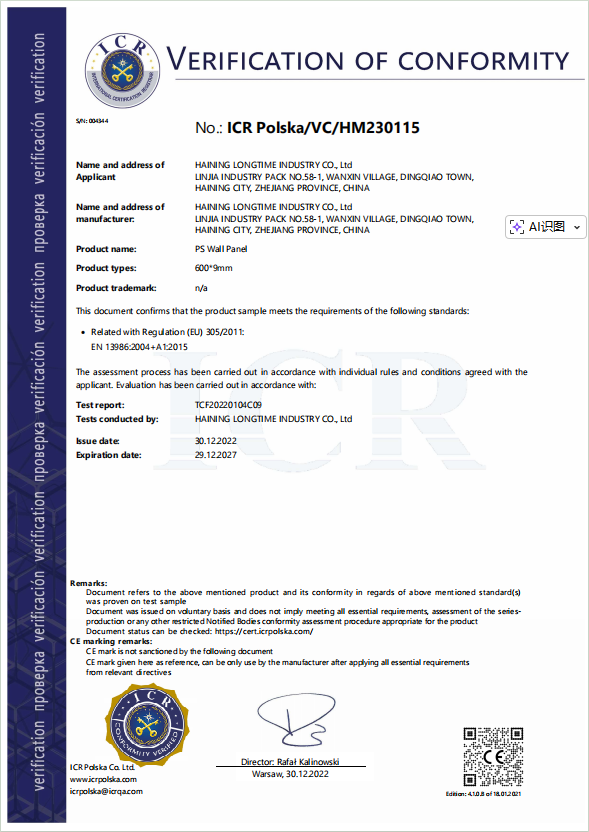
CPR (Construction Products Regulation, EU 305/2011): Construction products need CE marking. PS wall panels fall under "covering materials" or "decorative panels".
EN 13501-1: Fire classification. Common classes:
B-s1, d0: Difficult to ignite, low smoke, no droplets (best, but hard for PS to achieve)
C-s1, d0: Moderate flame retardancy – industry mainstream
D-s1, d0: Basic retardancy – accepted in some countries
E: Low retardancy – many projects do not accept
REACH: SVHC testing (currently 235+ substances). PS panels typically need testing for phthalates, heavy metals, flame retardant types, etc.
Additional (depending on customer requirements):
ISO 16000-6 / EN 16516: Indoor VOC emission test
EN 15102: Product standard for decorative wall coverings (optional but adds credibility)
Common pitfalls:
Fire tested but REACH not done – random inspection at customs leads to additional testing.
Fire test performed under an old standard (e.g., DIN 4102) that is no longer accepted.
3.2 Export to the United States (ASTM based, varies by state)
No federal mandatory certification, but test reports are required in the following situations:
Fire resistance: Most commercial projects require ASTM E84 (tunnel test). The report will show:
Flame Spread Index (FSI): Class A ≤25, Class B 26–75, Class C 76–200
Smoke Developed Index (SDI): ≤450
Formaldehyde: CARB P2 (California Air Resources Board) or TPCH (Toxics in Packaging). PS itself has no formaldehyde and is often exempt.
VOCs: LEED v4 certified projects may require CDPH (California Department of Public Health) standard.
State differences:
California: Strictest – CARB P2 and CDPH recommended.
New York, Massachusetts: Additional fire requirements – ASTM E84 Class A is common.
Other states: ASTM E84 Class C or higher is generally accepted.
Common pitfalls:
Customer asks for ASTM E84, you provide EN 13501 – not accepted in the US.
Thickness of test sample differs from actual product, making the report invalid.
3.3 Export to the Middle East (Saudi Arabia, UAE, Qatar, etc.)
Saudi Arabia (SASO / SABER):
Requires a COC (Certificate of Conformity) – building materials go through the SABER platform.
Fire requirements usually refer to ASTM E84 or EN 13501 depending on the project.
The test report must be issued by a laboratory recognised by the GSO (Gulf Standards Organization).
UAE (ESMA):
Also requires COC; fire standards follow UAE.S (mostly referencing EN or ASTM).
Civil buildings require Class C or higher fire rating.
Qatar:
QSAS certification; projects generally require EN 13501 Class C or B.
Common pitfalls:
The laboratory that issued the report is not on the GSO recognised list – the report is rejected.
Forgetting to obtain the COC before shipment leads to expensive and slow processing at the destination port.
3.4 Export to Australia / New Zealand
Fire: AS 1530.1 (similar to ASTM E84) or AS 3837 (cone calorimeter).
VOCs: Non-compliance may lead to rejection; ISO 16000 recommended.
New South Wales and Victoria have additional building codes.
3.5 Domestic Chinese market (GB standards)
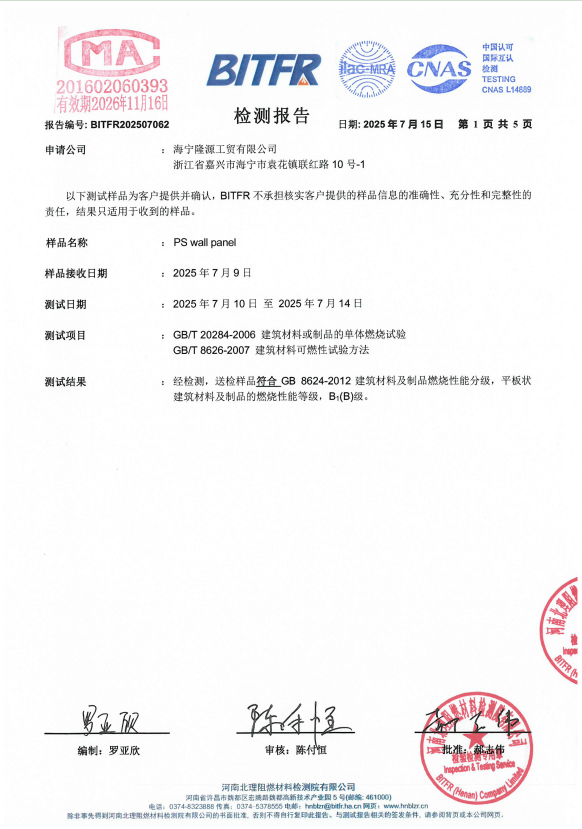
GB 8624-2012: Classification for burning behaviour. Class B1 (difficult to ignite), B2 (normally flammable), B3 (easily flammable). PS panels are usually B2 or B1 (with flame retardants).
GB 18580-2017: Formaldehyde emission limit – Class E1 ≤0.124 mg/m³ (PS panels easily pass).
GB/T 24149.1-2009: Product standard for plastic wall panels – includes dimensions, appearance, physical and mechanical properties.
4. How to Read a Test Report
When you receive a report, check these 5 items first:
- Report number and issue date– Is it still valid (typically 2–3 years)?
- Applicant / Client– Is it actually your supplier, or someone else?
- Testing laboratory– Is it accredited (CNAS, CMA, IAS, UKAS, etc.)? Unreliable small labs may fake reports.
- Sample description– Does the thickness, material, and colour match the product you are buying?
- Test results– Are the values compliant? Does the conclusion say "conforms"?
Special note: Some reports are only "commission tests" and do not have the authority of a "type test". Engineering tenders generally require a type test report.
5. Frequently Asked Questions (FAQ)
Q1: Where is your factory located?
A: No. 10-1 Lianhong Road, Yuanhua Town, Haining City, Zhejiang Province, China.
Q2: Do PS wall panels need UL certification for export to the US?
A: No. UL is a voluntary safety certification mainly for electrical products. It is not mandatory for wall panels. However, if you are supplying to a commercial project in New York, UL 94 (flammability of plastics) might be requested – that is a different standard. It is best to confirm with your customer.
Q3: European customers ask for a DoP (Declaration of Performance). Can you provide it?
A: Yes. Once we have CE certification, we issue a DoP that includes the product's performance parameters and the corresponding EN standards. This is required by EU regulations and is provided with the shipment.
Q4: Which laboratory issues your fire test reports?
A: We work with SGS (Switzerland), TÜV (Germany), Intertek (UK), the National Center for Quality Supervision and Testing of Fire Building Materials (China), and other CNAS-accredited third-party labs. All reports can be verified online.
Q5: If I export to multiple countries, do I need all the standards?
A: No. First determine your target market and only meet the requirements for that market. However, if your product may be sold to various markets, it is safer to meet the strictest requirements (e.g., EU CE + fire + REACH, US ASTM E84), which will cover most markets.
Q6: Do custom patterns or colours require new test reports?
A: It depends on whether the change affects performance. If only the colour changes (different pigments), fire and formaldehyde results remain largely the same, and the original report can be used. If the base material formulation changes (e.g., the amount of flame retardant), retesting is mandatory. It is best to confirm with the laboratory in advance.
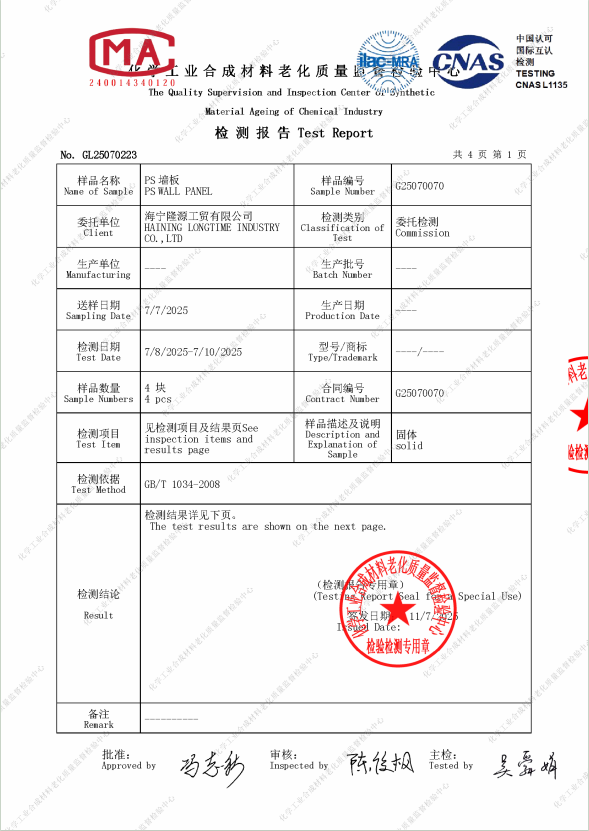
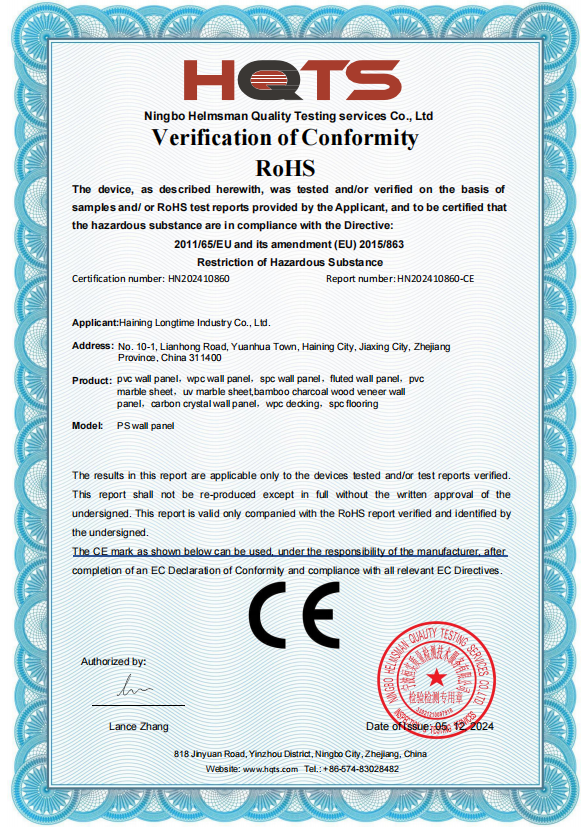
6. List of Test Reports We Provide (Reference)
For samples, quotes or technical consultation, please contact:
Official Website: http://www.ltpvcfactory.com
WhatsApp: +86 17757302351
Email: [email protected]
Sample Policy: Free samples and brochures are provided, with freight collect.