

 English
 Español

Are PVC ceiling boards waterproof? The short answer is yes, but the practical answer is more nuanced. A high-quality PVC ceiling board made with a dense, closed-cell core is genuinely waterproof and can handle humid environments such as bathrooms, kitchens, and laundry rooms. However, the performance in a real room depends on the panel structure, the edge seal, and the quality of installation.
If you are evaluating PVC for a moisture-prone area, this guide explains why PVC resists water, where failures happen, and what to verify before you buy.
What Makes a PVC Ceiling Board Waterproof?
PVC is a synthetic polymer with a molecular structure that does not attract water. Unlike wood, which swells, or gypsum, which crumbles, PVC is inherently non-absorbent. A typical waterproof PVC ceiling board is produced from PVC resin mixed with stabilizers, fillers, and impact modifiers, then extruded into a rigid sheet. The internal structure is either solid or closed-cell, meaning there are no open capillaries where water can travel.
The surface is usually decorated with a printed film or a UV coating. That outer layer is non-porous, so water beads on top and can be wiped off. Mold and mildew also have difficulty establishing because PVC does not provide a food source. That is why so many kitchens and bathrooms use PVC ceilings instead of traditional plaster.
To see where PVC sits against other common ceiling materials, consider the table below.
| Material | Water Resistance | Mold & Rot | Maintenance |
|---|---|---|---|
| PVC board | High | No mold or rot | Wipe clean |
| Gypsum board | Low | Can mold | Repaint regularly |
| Wood panel | Low to medium | Prone to rot | Requires sealing |
| Aluminum panel | High | No mold | Can corrode at cut edges |
Where PVC Ceiling Boards Excel and Where They Need Help
The board itself can be completely waterproof, but a ceiling is an assembly of panels, trims, and joints. The weakest points are the seams. If the panels are not machined with a proper tongue-and-groove or overlapping edge, moisture can seep between them over time. The same applies to cuts around light fixtures, vent fans, and pipes.
There is also a difference between solid PVC boards and lightweight foam boards. Some low-cost ceiling panels use a foamed PVC core with a thin surface layer. These boards can shrug off light moisture, but if an edge is cut or the surface is scratched, water can enter the spongy core and cause discoloration or odor. For true waterproof performance, look for a solid-core or high-density closed-cell panel with sealed edges.
Remember: a waterproof board and a waterproof ceiling are two different things. The board can be waterproof, but the ceiling only becomes water-resistant when all joints are sealed correctly.
How to Choose a Truly Waterproof PVC Ceiling Board
Not all PVC boards labeled waterproof are built the same. Here are the specifications that matter:
- Core density: A dense, solid core resists moisture better than a low-density foam core. Ask for the finished density or a cross-section sample.
- Surface coating: A UV-cured coating or laminated PVC film adds a continuous non-porous layer. It also helps with scrubbing.
- Edge profile: Tongue-and-groove edges create a mechanical lock that reduces moisture paths. Flat edges require extra caulk.
- Thickness: Typical ceiling boards range from 5 mm to 9 mm. Thicker panels tend to be stiffer and more resistant to sagging in high humidity.
- Fire and safety rating: Look for a B1 fireproof classification if the ceiling is in a commercial or high-use area.
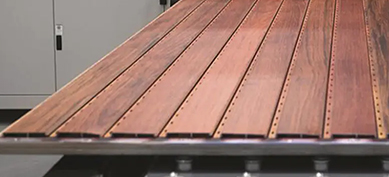
When you evaluate a specific product, check whether the board is described as having a closed-cell structure. At Longtime, the faux-stone textured PVC ceiling panel in our ceiling range is designed for wet indoor areas, with a waterproof surface and a dense core that resists deformation.
 Faux-Stone Textured PVC Ceiling Panel for Wet AreasThis PVC ceiling board features a waterproof, closed-cell core and faux-stone texture, making it a practical choice for moisture-prone indoor ceilings. Its dense structure resists deformation, and specifications can be customized.View Product →
Installation and Maintenance Tips for Long-Lasting Moisture Protection
The most common cause of water damage on a PVC ceiling is not the board itself, but gaps around the edges. Use these practices to keep the ceiling watertight:
- Fit panels tightly with a tongue-and-groove joint; avoid excessive force that can bend the edge.
- Apply a thin, continuous bead of neutral-cure silicone on each joint before locking panels together.
- Leave a 5 mm expansion gap at the perimeter and cover it with PVC cove molding or an aluminum angle.
- Seal every penetration, such as downlights, smoke detectors, and vent pipes, with a compatible silicone sealant.
- Install or maintain an exhaust fan to remove humid air before it settles on any cold surface.
For a step-by-step process from ceiling preparation to trimming, see our guide on how to install a PVC ceiling panel.
Maintenance is refreshingly simple. Wipe the surface with a soft cloth and a mild detergent dissolved in water. Avoid abrasive scouring pads, and do not use acetone or other strong solvents, as they can dull the protective coating.
FAQ
Q1: Are all PVC ceiling boards 100% waterproof?
No. The term waterproof is used broadly in the market. Dense solid-core PVC boards are waterproof, while some lightweight foam boards are only water-resistant. Always check the product specification for a closed-cell core and a sealed surface.
Q2: Can PVC ceiling boards be installed in a shower room or steam room?
Yes, provided the panels are rated for continuous humidity and every joint is sealed. Steam can drive moisture through unsealed intersections, so pay extra attention to the eaves and corners in steam-heavy spaces.
Q3: Do PVC ceiling boards develop mold or mildew?
PVC itself does not support mold growth. However, a dirty surface can accumulate dust and soap residue, which may attract mildew. Regular cleaning with a mildew-resistant bathroom cleaner prevents this.
Q4: How long does a waterproof PVC ceiling last?
A high-quality PVC ceiling board installed correctly can last 20 years or more. The main cause of premature failure is installation gaps that allow moisture to reach the substrate or the back of the panel.
Bottom line: PVC ceiling boards are waterproof when they are manufactured with a dense core, given a protective surface, and installed with sealed joints. They outperform traditional plaster and wood in humid spaces and offer a practical, low-maintenance ceiling solution. If you prioritize board density and proper seam sealing, a PVC ceiling will hold up for decades.