

 English
 Español
As a representative product of wood-plastic composites, the quality of WPC wall panels varies significantly between manufacturers. Understanding the internal structure and surface technology of the product helps determine whether a WPC panel is good or not. This article breaks down the components, key parameters, and process grades of WPC wall panels from a technical perspective.
1. Basic Product Structure
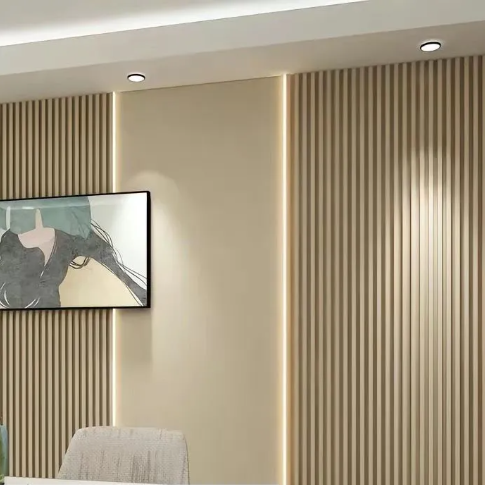
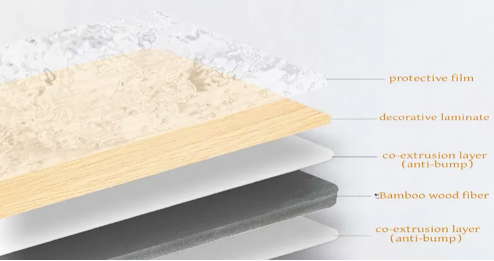
WPC wall panels can be divided into three layers from inside to outside:
Substrate layer: Accounts for 80% to 90% of the panel thickness. Formed by extruding a mixture of wood powder, plastic (HDPE or PVC), coupling agents, lubricants, fillers, and flame retardants. The quality of the substrate layer determines the panel's strength, density, water resistance, and service life.
Decorative layer: A thin layer covering the substrate surface, providing wood-grain, stone-grain, or other visual effects. Low-end products use printed film heat-pressed onto the surface; mid-to-high-end products use 3D embossing with synchronized register technology.
Protective layer: A transparent coating above the decorative layer, providing wear resistance, scratch resistance, UV resistance (for outdoor grades), and stain resistance. The thickness and material of the protective layer directly affect product durability.
Co-extruded products are different. They use two extruders simultaneously: the surface layer uses a high-weatherability material (such as ASA or modified PVC) with a thickness of about 0.5 to 1 mm, while the inner layer uses ordinary WPC. The two layers bond thermally during extrusion and will not separate.
2. Key Dimensional Parameters
Thickness: Common indoor wall thicknesses are 5 mm, 7 mm, and 9 mm. Greater thickness provides higher bending strength and flatter panel surfaces. Panels of 9 mm or more can be used for furring strips at wider spacing (60 cm). For outdoor walls, recommended thicknesses are 12 mm, 15 mm, 20 mm, or even 30 mm. Greater thickness provides better wind pressure resistance and impact resistance.
Width: Common widths are 150 mm, 180 mm, 200 mm, and 219 mm. Narrow panels suit small areas or curved walls; wide panels suit large-area installations with fewer joints.
Length: Standard lengths are 2.2 m, 2.4 m, 2.7 m, 3 m, and 4 m. Custom lengths up to 6 m are available. Longer panels reduce horizontal joints but are more difficult to transport and handle.
Groove dimensions: The fit tolerance of the tongue and groove affects joint tightness after installation. High-quality products control tolerance within 0.2 mm, ensuring tight joints without movement.
3. Surface Technology Details
Printed film lamination: A printed decorative film is heat-pressed onto a smooth PVC or WPC substrate. Advantages: low cost, rich colors. Disadvantages: flat surface without three-dimensional texture, and potential bubbling or delamination over time.
3D embossing: A steel roller engraved with wood-grain texture presses into the panel surface, creating a raised and recessed texture. Fingers can actually feel the grain. Advantages: realistic texture that does not wear away. Disadvantages: higher cost, limited embossing depth (typically 0.3 to 0.5 mm).
Synchronized register technology: An upgrade of 3D embossing. The printed pattern and the embossing roller texture are precisely aligned so that the raised/recessed areas match the wood grain's annual rings and vessels exactly. This is the most advanced surface treatment technology, providing the closest visual effect to natural wood.
Co-extruded surface: During extrusion, the surface layer uses ASA or modified PVC. The co-extruded layer has inherent color and weatherability, requiring no subsequent printing or embossing. Advantages: excellent UV resistance, long outdoor life, no delamination. Disadvantages: higher cost, fewer color options.
Applied protective coating: A UV-cured or water-based paint is sprayed over the decorative layer, forming a transparent protective film. This increases wear and scratch resistance. Outdoor grades require UV stabilizers. A good protective layer has a thickness of 0.1 to 0.2 mm and good scratch resistance
4. Product Classification
By application scenario:
- Indoor grade: Waterproof and moisture-resistant, contains little or no UV stabilizers, not suitable for direct sunlight.
- Outdoor grade: Contains UV stabilizers and anti-aging additives, can withstand long-term sun and rain exposure.
By cross-section structure:
- Solid panel: High strength, suitable for outdoor and commercial projects.
- Hollow panel: Lightweight, low cost, suitable for indoor walls. Hollow structures come with various cavity designs; more cavities mean better load-bearing capacity.
By installation method:
- Clip-in panel: Tongue-and-groove with hidden clips, screws hidden in slots, clean appearance.
- Flat-edge panel: No groove, requires battens or exposed screws for fixing.
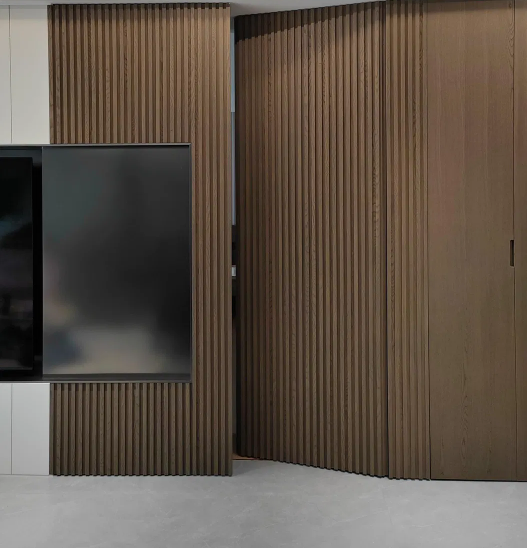
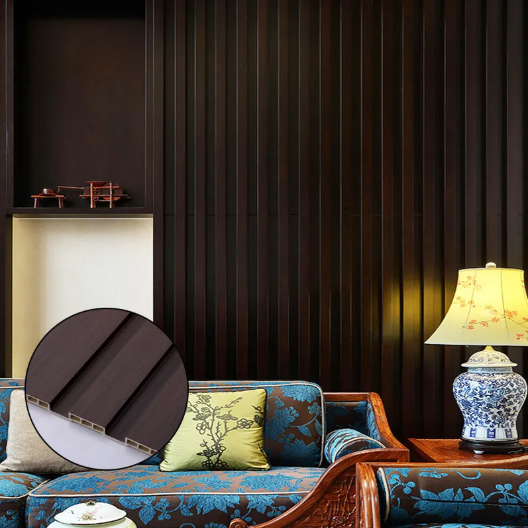
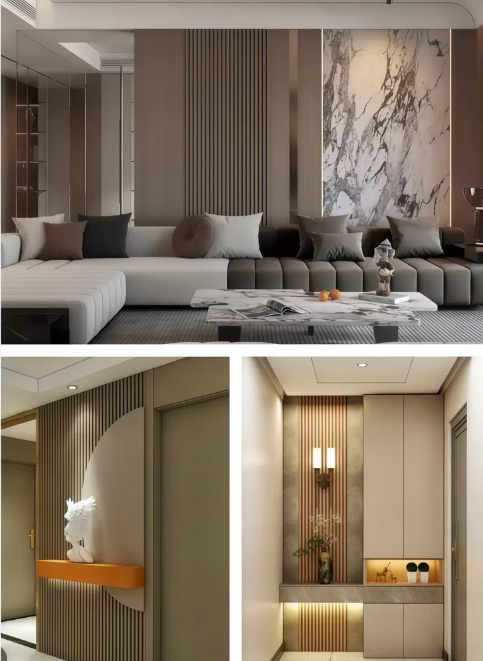
- Slatted panel: Evenly spaced grooves on the surface, providing acoustic function.
By surface effect:
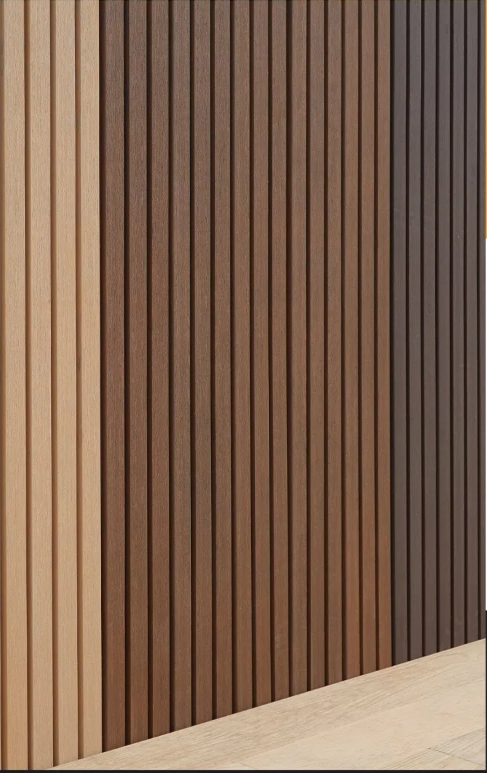
- Wood-grain panel: Oak, walnut, teak, cherry, ash, and many other textures.
- Stone-grain panel: Marble, slate, cultured stone, etc.
- Solid color panel: Matte white, grey, black, etc.
- Slatted panel: U-groove or V-groove, for acoustic or decorative purposes.
5. Key Performance Indicators
Density: 1.2 to 1.4 g/cm³. Below 1.2 may lack strength; above 1.4 may be too brittle.
Bending strength: Indoor grade not less than 20 MPa; outdoor grade not less than 25 MPa. Higher values mean better resistance to deformation.
Water absorption rate: High-quality products below 0.5%; standard products below 1%. Lower rates mean better moisture resistance.
Shore hardness: 60 to 70 D. Higher hardness means better scratch resistance but also more brittleness.
Heat deflection temperature: HDPE-based: approximately 75 to 80°C; PVC-based: approximately 65 to 70°C. Higher values mean better resistance to deformation at high temperatures.
Coefficient of linear thermal expansion: 2.0 to 3.5 × 10⁻⁵ /K. Lower values mean less dimensional change with temperature fluctuations.
UV aging resistance (outdoor grade): QUV test 500 to 1000 hours, color difference ΔE < 3 to 5. Lower values mean better color retention.
Fire rating: B1 grade (difficult to ignite), oxygen index > 30.
Formaldehyde emission: Not detected, compliant with E0 grade or CARB Phase 2.
6. Product Specification Table (Example)
| Parameter | Indoor Standard | Indoor Premium | Outdoor UV-Resistant |
| Thickness | 5 mm, 7 mm | 9 mm | 12 mm, 15 mm, 20 mm |
| Width | 150 mm, 200 mm | 200 mm | 180 mm, 219 mm |
| Length | 2.2-4 m | 2.2-4 m | 2.2-4 m |
| Surface technology | Printed film | 3D embossing + synchronized register | Co-extruded or UV coating |
| Density | 1.2 g/cm³ | 1.3 g/cm³ | 1.35 g/cm³ |
| Bending strength | 22 MPa | 28 MPa | 30 MPa |
| Water absorption | <0.8% | <0.5% | <0.3% |
| UV resistance | None | None | 500h ΔE<3 |
| Suitable for | Indoor dry areas | All indoor areas | Balconies, facades, gardens |
7. How to Choose Based on Product Parameters
Select thickness by need: 5-7 mm is sufficient for ordinary accent walls. For full-wall installation with wider furring strip spacing, choose 9 mm or more. For outdoor walls, choose 12 mm or more.
Select base material by environment: HDPE-based resists low temperatures, suitable for northern outdoor use. PVC-based has better flame retardancy, suitable for indoor use.
Select surface by budget: Printed film for limited budgets; 3D embossing for better texture; outdoor requires co-extrusion or UV coating.
Check reports against standards: Ask suppliers for test reports and verify that density, bending strength, water absorption, UV resistance, and fire rating meet the required standards.
8. Frequently Asked Questions
Q: Why is there slight color variation between different batches of the same product?
A: Natural wood powder has batch-to-batch color variation, and pigment metering errors are unavoidable. Reputable manufacturers control color difference to ΔE < 1.0.
Q: Are longer panels always better?
A: Longer panels reduce horizontal joints but are more difficult to transport and install. Lengths of 2.4 m to 3 m are the most commonly used.
Q: Can the surface layer of co-extruded products detach?
A: No. The co-extruded layer bonds with the substrate in a molten state at the molecular level and will not delaminate.
Q: How to distinguish printed panels from embossed panels?
A: Touch with fingers. Embossed panels have a raised texture; printed panels are smooth. You can also scratch gently with a fingernail – printed panels may lose color.
Summary
The quality of WPC wall panels is reflected in the substrate formulation, cross-section structure, surface technology, and key performance indicators. Thickness, density, bending strength, water absorption rate, and UV resistance grade are core parameters. Understanding these technical details helps you make more informed purchasing decisions.
For detailed product specifications, test reports, or samples, please contact us.
For samples, quotes or technical consultation, please contact:
Official Website: http://www.ltpvcfactory.com
WhatsApp: +86 17757302351
Email: [email protected]
Sample Policy: Free samples and brochures are provided, with freight collect.