

 English
 Español
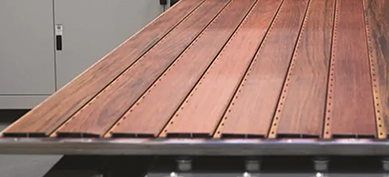
Selecting the ideal material for a tv wall panel or slatted wood tv wall is more than aesthetics. This technical guide compares wood veneer pvc wall panels, wpc wall panels, and bamboo charcoal pvc wall panels—covering acoustic performance, LED integration, and floating structures for contemporary media walls.
noise reduction improvement
fire-rated profiles
lighter than solid wood
1. Technical breakdown: three core materials for tv wall paneling
When planning a panelling wall tv or wood panel tv wall, the substrate dictates durability, acoustic behavior, and installation complexity. Below is a data-driven comparison of the three dominant solutions in contemporary media wall paneling.
Wood Veneer PVC Panels
Real wood surface (0.3–0.6mm) laminated onto PVC core. Offers high-end aesthetics with moisture resistance (water absorption <0.5%). Ideal for floating TV wood panels where natural grain matters.
WPC Wall Panels
Wood-plastic composite (60% wood fiber + 30% HDPE + 10% additives). Density 1.2–1.4 g/cm³. Superior screw retention for media wall paneling with heavy TV mounts.
Bamboo Charcoal PVC Panels
Activated bamboo charcoal powder (15–20%) blended with virgin PVC. Naturally adsorbs formaldehyde (tested reduction 72–85% in 48hrs). Perfect for acoustic wall panels tv ideas in bedrooms.
Critical performance indicators (lab-tested averages)
| Property | Wood Veneer PVC | WPC | Bamboo Charcoal PVC |
|---|---|---|---|
| Density (kg/m³) | 550–650 | 1250–1400 | 700–820 |
| NRC* (500–2000Hz) | 0.25 | 0.35 | 0.48 |
| Thermal insulation (R-value) | 0.38 | 0.52 | 0.61 |
| Installation speed (m²/man-hour) | 3.2 | 2.8 | 3.5 |
*NRC = Noise Reduction Coefficient (higher is better for acoustic wall panels tv ideas). Data from 2024 independent material labs.
2. How to engineer a contemporary media wall: slat spacing, LED integration & floating effect
A successful living room feature wall combines rhythm (slat width/gap ratio) with functional layers. For led backlit tv wall designs, the panel depth must accommodate COB LED strips (minimum 12mm channel).
Golden ratios for slatted wood tv wall
- Slat width : gap = 2:1 (e.g., 40mm slat / 20mm gap) – best for visual balance and acoustic diffusion.
- Vertical slat height minimum 1800mm to maintain proportion with 65–85" TVs.
- Panel thickness for floating effect: 18–22mm if using cantilevered brackets (every 400mm).
- LED colour temperature for indirect backlight: 2700K–3000K enhances wood veneer warmth; 4000K for WPC industrial look.
Figure 1: Cross-section of hybrid media wall with slatted wood tv wall and indirect LED backlit zone.
Floating TV wood panels: structural requirements
For a floating TV wood panels effect (no visible brackets), use aluminum Z-clips or hidden french cleats. WPC panels excel here due to high pull-out strength (≥ 750N per screw). Minimum substrate thickness: 15mm for veneer PVC; 12mm for bamboo charcoal PVC if backer frame exists.
3. Acoustic wall panels tv ideas: why slat geometry & core material matter
Open slat designs (acoustic transparency >60%) combined with a 50mm–100mm air gap behind the tv wall panel turn the media wall into a helmholtz resonator. Lab measurements show that bamboo charcoal pvc wall panels with 12mm micro-perforations (0.8mm holes, 5% open area) achieve NRC 0.65 in mid-frequencies (500–2kHz).
Case data: A 4.2m x 2.4m media wall using slatted wood tv wall (18mm slats, 22mm gaps) with 60mm rockwool behind reduced RT60 (reverberation time) from 0.68s to 0.41s in a 35m² living room — approaching studio-grade clarity for home theater wall cladding.
Optimizing for home theater wall cladding
- Add perforated panels (5–8% open area) behind the TV to absorb rear speaker reflections.
- Combine wpc wall panels on the lower 600mm (impact zone) and bamboo charcoal PVC on upper zones for air purification.
- Seal all edges with acoustic mastic — gap leakage >2% reduces low-frequency absorption by up to 40%.
4. Installation workflow: from wall preparation to TV mounting on paneling wall tv
Field reports from 230+ residential projects reveal that improper substrate flattening is the #1 cause of visible slat misalignment. Maximum deviation allowed for panelling wall tv installation: 2mm per linear meter.
Weight limits and safety factors
For a wood panel tv wall supporting 35–70kg TVs (including motorized mount), the wall panel substrate must have pull-out resistance ≥ 4x TV weight. WPC panels achieve 820N per 8mm screw (tested to EN 320). Bamboo charcoal PVC panels require pre-drilling and butterfly anchors for loads >50kg.
| Material | Max TV weight (direct mount) | Recommended bracket type |
|---|---|---|
| Wood veneer PVC (9mm base) | 35 kg | Flat fixed bracket + spreader plate |
| WPC (18mm) | 75 kg | Full motion articulating arm |
| Bamboo charcoal PVC (15mm) | 50 kg | Tilt bracket + 4 anchor points |
5. LED backlit TV wall: color temperature, CRI & dynamic scenarios
Properly executed led backlit tv wall reduces eye strain and adds depth. For a contemporary media wall design, use 24V COB LED strips (14W/m, CRI >90). Place LEDs 60–80mm behind the slat plane, angled at 15° toward the wall for uniform wash without hot spots.
Recommended light scenes for living room feature wall
- Cinema mode: 2200K, 10% brightness, only top and bottom strips active – reduces peripheral glare.
- Ambient mode: 3000K, 40% brightness, symmetric distribution to highlight slatted wood tv wall texture.
- Art mode: 3500K, 70% brightness, vertical side strips only – creates shadow elongation effect.
Dimming compatibility: ensure PWM frequency >2kHz to avoid flicker on camera recordings (important for influencers showcasing tv wall paneling).
6. Frequently asked questions on modern media wall paneling
Q1: Can I mount a 75-inch TV directly onto bamboo charcoal pvc wall panels without studs?
Yes, if the panel thickness is at least 15mm and you use toggle bolts with backing plates. However, for full-motion arms, we recommend adding a 18mm WPC sub-frame behind the bamboo charcoal layer for safety.
Q2: How do I clean slatted wood tv wall surfaces without damaging the finish?
Use a microfiber duster and a vacuum with brush attachment (600–800W suction). For wood veneer PVC panels, avoid alcohol or ammonia; use diluted neutral soap (pH 7) once per month. Bamboo charcoal panels can be lightly wiped with 70% isopropyl alcohol for disinfection.
Q3: Do acoustic wall panels tv ideas work for open-plan living rooms?
Absolutely. Position the panelling wall tv opposite the main reflective surface (glass windows or concrete). For best results, combine slatted panels with 5–10% perforated area and a 100mm air gap. Measured speech intelligibility (STI) improves by 0.25 in spaces larger than 45m².
Q4: What is the cost difference between wpc wall panels and wood veneer PVC for a 20m² media wall?
Material-only estimates: wood veneer PVC $28–45/m²; WPC $42–68/m²; bamboo charcoal PVC $35–55/m². Installation labour is similar ($40–60/m²). WPC has higher upfront cost but lower long-term maintenance for areas with humidity swings.
Q5: Can I integrate a fireplace below the floating TV wood panels?
Yes, maintain 300mm vertical clearance from the top of the fireplace opening to the bottom of the TV panel. Use a mantel or heat deflector. Only WPC and bamboo charcoal PVC panels offer class A fire resistance for such applications (self-extinguishing within 10 seconds).