

 English
 Español
The Core Problem with Solid Wood in Wet Environments
Solid wood has long been prized for its natural beauty and warmth. Yet in high-humidity spaces — bathrooms, kitchens, laundry rooms, basements, and tropical-climate interiors — solid wood consistently underperforms. The science is straightforward: wood is hygroscopic, meaning it absorbs and releases moisture from the surrounding air. When relative humidity climbs above 60%, solid wood panels begin to swell. When humidity drops, they shrink. This cycle of expansion and contraction creates warping, cracking, cupping, and joint separation within months of installation.
In regions where annual humidity averages 70–85% — such as coastal areas, Southeast Asia, or humid continental climates — solid wood wall panels can begin showing visible distortion in as little as 3 to 6 months. Paint and stain finishes peel away, mold colonies establish themselves inside the wood grain, and structural integrity is gradually compromised. Replacement becomes necessary far sooner than anticipated, driving up total ownership costs dramatically.
This is precisely why architects, interior designers, and facility managers are moving away from solid wood in moisture-prone spaces — and turning toward a smarter engineered alternative.
What Makes Wood Veneer PVC Wall Panels Different
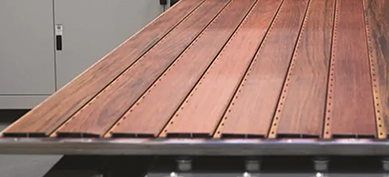
Wood Veneer PVC Wall Panels combine a thin layer of real natural wood veneer — typically 0.3mm to 0.6mm thick — bonded to a rigid PVC substrate. The result is a panel that delivers the authentic visual texture and warmth of natural timber while the underlying PVC core provides dimensional stability, moisture resistance, and long-term durability that solid wood cannot match.
The PVC core is inherently non-porous. Unlike solid wood, it does not absorb water vapor from the air. This means the panel maintains its shape, flatness, and surface integrity regardless of ambient humidity levels. The veneer surface, being extremely thin and fully encapsulated by protective coatings, is isolated from the moisture exchange processes that cause problems in solid timber planks.
How the Panel is Constructed
A standard wood veneer PVC wall panel consists of the following layers, from outermost to innermost:
- UV-cured protective topcoat — scratch and stain resistant, seals the veneer surface
- Natural wood veneer layer — authentic grain, color variation, and texture
- High-strength adhesive layer — bonds veneer to substrate without delamination
- Rigid PVC core — provides structural support and moisture impermeability
- Backing film or balancing layer — prevents panel warping by equalizing surface tension
This engineered structure addresses every major weakness of solid wood while preserving the aesthetic qualities that designers and homeowners value most.
Key Advantages Over Solid Wood in High-Humidity Conditions
1. Dimensional Stability Under Humidity Fluctuations
PVC substrates have a moisture absorption rate of less than 0.5% by weight, compared to solid hardwoods which can absorb 8–12% or more. This fundamental difference means wood veneer PVC panels retain their original dimensions even when installed in spaces where humidity regularly swings between 40% and 90%. There is no swelling, no shrinkage, and no resultant cracking or joint gaps.
In practical terms, this stability translates directly into long-term surface flatness. Panels installed in a hotel bathroom in 2020 will look as flat and flush in 2030 as they did on day one — something that cannot be guaranteed with solid wood.
2. Resistance to Mold and Mildew Growth
Mold requires three conditions to grow: moisture, oxygen, and an organic food source. Solid wood provides all three. Its cellular structure holds moisture and its organic lignin and cellulose content serve as nutrients for fungal colonies. Once mold establishes itself inside wood, surface-level cleaning rarely eliminates it permanently.
The PVC core of wood veneer panels eliminates the moisture retention and organic substrate that mold needs. With the veneer surface sealed under a UV-cured topcoat, mold has no entry point and no food source. Independent testing of PVC-substrate panels shows mold resistance ratings that comply with ASTM G21 and similar international standards — a critical specification for healthcare facilities, hospitality environments, and residential bathrooms.
3. Dramatically Lower Maintenance Requirements
Solid wood in humid environments demands a demanding maintenance regimen: periodic resealing, refinishing, mold treatment, joint recaulking, and eventual panel replacement. These costs accumulate rapidly in commercial settings where labor is expensive and facility downtime is costly.
Wood veneer PVC wall panels require only routine wiping with a damp cloth and mild detergent. There is no periodic sealing required, no refinishing, and no vulnerability to cleaning agents that would strip solid wood finishes. This maintenance simplicity is a major factor in total cost of ownership calculations.
4. Superior Longevity in Wet Zones
When properly installed, wood veneer PVC wall panels in high-humidity environments have an expected service life of 15 to 25 years, compared to 5 to 10 years for solid wood panels under equivalent conditions. This extended lifespan directly reduces the frequency and cost of renovation cycles — a particularly important consideration for hotels, rental apartments, commercial kitchens, and healthcare facilities where renovation disruption is expensive.
5. Fire and Safety Performance
PVC-core panels can be manufactured to meet Class B1 or equivalent fire rating standards. This is a significant advantage over solid wood in commercial and institutional applications, where building codes increasingly mandate fire-retardant wall finishes in bathrooms, corridors, and kitchens. Solid wood panels, by contrast, require chemical fire-retardant treatment that can affect surface appearance and may need to be reapplied over time.
Comparing Wood Veneer PVC Panels vs. Solid Wood: At a Glance
The table below summarizes the key performance differences relevant to high-humidity installations:
| Performance Factor | Wood Veneer PVC Panels | Solid Wood Panels |
|---|---|---|
| Moisture Absorption Rate | Less than 0.5% | 8–12%+ |
| Warping / Swelling Risk | Very Low | High |
| Mold Resistance | Excellent | Poor to Moderate |
| Expected Lifespan (humid zones) | 15–25 years | 5–10 years |
| Maintenance Frequency | Low (routine cleaning only) | High (sealing, refinishing) |
| Fire Resistance | Class B1 achievable | Requires chemical treatment |
| Natural Wood Aesthetic | Yes (real veneer surface) | Yes |
| Weight | Lighter than solid wood | Heavier |
| Installation Ease | High — click-lock or adhesive | Moderate — requires skilled carpentry |
| Environmental Impact | Lower — uses less timber | Higher — requires full timber volume |
Ideal Application Spaces for Wood Veneer PVC Wall Panels
Understanding where these panels perform best helps designers and specifiers make confident decisions. The following spaces are particularly well-suited to wood veneer PVC panel installations:
- Residential bathrooms and en-suites — where steam from hot showers creates sustained high humidity daily
- Hotel guest rooms and bathrooms — where aesthetic consistency and low maintenance are both critical over a 10+ year renovation cycle
- Kitchen backsplash and cabinetry surrounds — where steam, grease splatter, and cleaning agents degrade solid wood rapidly
- Basement and below-grade spaces — where ground moisture and condensation create chronically elevated humidity
- Spa and wellness centers — where wall surfaces are routinely exposed to steam, moisture, and cleaning chemicals
- Laundry rooms and utility areas — where humidity cycles are frequent and intense
- Tropical-climate interiors — where outdoor humidity regularly exceeds 80% and infiltrates interior spaces
- Commercial healthcare facilities — where hygiene standards require surfaces that resist microbial growth and tolerate frequent disinfection
The Aesthetic Argument: Real Wood Look Without Real Wood Risks
One of the most persistent objections to engineered wall panels has been the assumption that they look artificial or cheap. This is no longer a valid concern with modern wood veneer PVC panels. Because the surface layer is genuine natural wood veneer — not a printed film or photographic reproduction — the visual and tactile authenticity is indistinguishable from solid wood at normal viewing and touching distances.
Natural veneer captures the full complexity of real timber: genuine grain variation, authentic color gradation between heartwood and sapwood, and the subtle surface texture that characterizes each wood species. Popular veneer species used in these panels include oak, walnut, teak, ash, cherry, and maple — each with its distinctive aesthetic character.
Design Versatility Across Styles
Wood veneer PVC panels are available in a wide range of finishes and profiles that suit different interior design directions:
- Matte and satin finishes — for contemporary, Japandi, and minimalist interiors
- Brushed and wire-brushed textures — for rustic, farmhouse, and industrial aesthetics
- High-gloss lacquered veneer — for luxury hotel and premium residential applications
- Wide-plank formats — for bold, statement wall treatments in living areas and lobbies
- Grooved and fluted profiles — for dimensional accent walls with strong visual rhythm
This design flexibility allows architects and interior designers to specify the same panel system across multiple rooms or entire projects — achieving aesthetic cohesion while benefiting from the moisture performance advantages in wet zones.
Installation Efficiency and Structural Benefits
Beyond performance, wood veneer PVC panels offer meaningful advantages during the installation phase that solid wood cannot match.
Lightweight Construction
PVC-core panels typically weigh 30–50% less than equivalent solid wood panels. This weight reduction has cascading benefits: faster handling by installation crews, reduced structural load on wall systems, and the ability to install on substrates — including existing tiled walls — that could not support the weight of solid timber cladding. In renovation projects especially, this weight advantage can eliminate the need for structural reinforcement work.
Click-Lock and Adhesive Installation Systems
Most wood veneer PVC panels are designed with integrated click-lock or tongue-and-groove joining systems that allow rapid, tool-light installation. A skilled installer can cover 20–30 square meters per day, compared to 8–15 square meters for precision solid wood paneling that requires careful fitting, gluing, nailing, and finishing. This speed advantage translates directly into lower labor costs and shorter project timelines.
Thermal and Acoustic Properties
The PVC core provides modest thermal insulation and acoustic damping properties. In residential bathrooms and hotel rooms, this can contribute to a more comfortable acoustic environment — reducing the hollow echo effect that hard tile surfaces produce. While wood veneer PVC panels are not a primary acoustic solution, their contribution to sound absorption is a genuine secondary benefit over tile or bare concrete alternatives.
Environmental Considerations and Responsible Sourcing
A frequent question raised about wood veneer panels concerns their environmental profile relative to solid wood. The answer is nuanced but generally favorable to the veneer option.
A single cubic meter of solid timber can yield solid wood panels for approximately 20–30 square meters of wall coverage. The same volume of timber, sliced into 0.4mm veneer, can cover 600 to 800 square meters of wall surface. This extraordinary yield ratio means that veneer production places dramatically less pressure on timber resources for an equivalent area of installation.
When veneer is sourced from certified sustainable forestry operations — verified by FSC or PEFC certification — the environmental footprint of wood veneer PVC panels is substantially lower than solid wood on a per-square-meter basis. The PVC substrate, while a synthetic material, contributes to overall durability that extends product life and reduces replacement frequency — itself an environmental benefit.
Responsible specifiers should request documentation of veneer origin and certification status when procuring these panels for green building projects or applications targeting LEED, BREEAM, or equivalent sustainability rating credits.
Cost Analysis: Upfront vs. Total Cost of Ownership
A common misconception is that wood veneer PVC panels cost more than solid wood alternatives. In reality, the upfront material cost is often comparable or lower, and the total cost of ownership over a 15–20 year building lifecycle strongly favors the engineered panel.
Factors That Reduce Long-Term Costs
- Elimination of periodic refinishing — solid wood requires sanding and resealing every 3–5 years in humid environments
- No mold remediation costs — mold treatment and replacement of affected solid wood panels can run USD 50–200 per square meter including labor
- Extended replacement cycles — replacing panels every 20 years instead of every 7–10 years reduces lifecycle renovation costs by 50% or more
- Lower installation labor costs — faster installation reduces labor charges by 20–40% compared to solid wood paneling
- No structural reinforcement needed — lighter panels avoid the cost of wall reinforcement in renovation scenarios
For a commercial project covering 500 square meters of bathroom or kitchen wall surface, switching from solid wood to wood veneer PVC panels can result in total lifecycle savings of USD 30,000 to 80,000 over a 20-year period, depending on labor rates and local material costs.
Frequently Asked Questions
Q1: Are wood veneer PVC wall panels truly waterproof, or just water resistant?
The PVC core is fully waterproof and will not absorb water. The natural wood veneer surface is sealed with a UV-cured topcoat that makes it highly water resistant. For direct water exposure — such as shower walls — it is advisable to use panels rated specifically for wet zone installation and to seal panel joints with waterproof silicone. For ambient humidity and splash-zone applications, standard wood veneer PVC panels perform excellently without additional treatment.
Q2: Can these panels be installed directly over existing bathroom tiles?
Yes. The lightweight nature of wood veneer PVC panels makes them suitable for direct installation over existing ceramic or porcelain tile using construction adhesive, provided the tile surface is structurally sound, flat, and free of loose or hollow sections. This retrofit capability is a significant advantage in renovation projects where tile removal would be costly and disruptive.
Q3: What wood veneer species are most suitable for high-humidity areas?
Since the veneer is sealed and protected, the specific species has less impact on moisture performance than it would in solid wood applications. Oak, teak, and walnut veneers are popular choices for humid environments due to their visual appeal. Teak is particularly associated with moisture resistance in traditional applications, making it a reassuring choice for clients familiar with wood properties.
Q4: How do wood veneer PVC panels compare to ceramic tile in wet areas?
Both materials offer excellent moisture resistance. The primary advantages of wood veneer PVC panels over ceramic tile are warmth and comfort (both visual and tactile), faster installation, lighter weight, better acoustic properties, simpler cutting and customization on site, and the ability to avoid grout lines that harbor mold and require ongoing maintenance.
Q5: Is the veneer surface easy to scratch or damage?
The UV-cured topcoat provides meaningful scratch resistance for normal residential and commercial use. Abrasive materials or sharp objects can scratch the surface, as with any finished wood product. Panels are rated by surface hardness class — specifiers should select panels with higher abrasion resistance ratings for high-traffic commercial applications such as hotel corridors or public restrooms.
Q6: Do wood veneer PVC panels emit harmful VOCs?
Reputable manufacturers test their panels to E0 or E1 formaldehyde emission standards, ensuring VOC levels are within safe limits for indoor use. When purchasing these panels, request test certificates confirming compliance with applicable emission standards such as European EN 717-1 or equivalent national standards relevant to your project location.
Q7: Can the panels be cut and shaped on site?
Yes. Wood veneer PVC panels can be cut using standard woodworking tools — circular saws, jigsaws, or table saws with fine-tooth blades. The PVC core cuts cleanly without chipping, and the veneer surface requires no special tooling. This on-site workability makes it easy to fit panels around obstacles, electrical outlets, plumbing fixtures, and architectural details without specialized equipment.