

 English
 Español
WPC Wins for Most Applications
If you are choosing between WPC and PVC for wall panels, WPC (Wood Plastic Composite) is the better choice in most scenarios — particularly for interior applications that demand aesthetics, acoustic performance, and environmental responsibility. PVC panels remain competitive in high-moisture or budget-driven environments. The right answer depends on your specific project requirements, which this article breaks down in detail.
What Are WPC and PVC Wall Panels?
WPC Wall Panels
WPC stands for Wood Plastic Composite. It is made by blending wood fiber (typically 50–70%) with thermoplastic polymers such as polyethylene or polypropylene, along with additives for UV resistance, color stability, and structural integrity. The result is a material that looks and feels like natural wood while offering the durability of plastic. WPC Acoustic Wall Panels are a specialized category engineered to reduce sound transmission and improve room acoustics, widely used in offices, home theaters, hotels, and commercial spaces.
PVC Wall Panels
PVC stands for Polyvinyl Chloride. PVC wall panels are 100% synthetic plastic, manufactured without any natural fiber content. They are lightweight, fully waterproof, and easy to install. PVC panels are commonly found in bathrooms, kitchens, and areas that require low-cost, moisture-resistant wall cladding.
Material Composition and Structural Differences
Understanding the core composition helps explain why each material performs differently across applications:
| Property | WPC | PVC |
| Core Material | Wood fiber + plastic polymer | 100% synthetic PVC resin |
| Wood Content | 50–70% | 0% |
| Surface Texture | Natural wood-like grain | Smooth or embossed plastic |
| Density | Medium to high (approx. 1.0–1.3 g/cm³) | Low to medium (approx. 0.8–1.1 g/cm³) |
| Recyclability | Partially recyclable | Recyclable but requires special processing |
Acoustic Performance: WPC Has a Clear Advantage
Acoustic performance is one of the most significant differentiators between the two materials. WPC panels can achieve Sound Transmission Class (STC) ratings of 30–50 depending on thickness and installation method, making them suitable for noise-sensitive environments like conference rooms, recording studios, and hotel corridors.
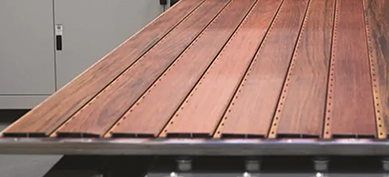
The wood fiber content within WPC acts as a natural sound absorber. When combined with a hollow groove or perforated surface design — common in WPC acoustic panels — the material can reduce noise reflection and reverberation significantly. In contrast, PVC panels offer minimal acoustic benefit. Their dense, smooth plastic surface tends to reflect sound rather than absorb it, which can worsen echo problems in hard-surfaced rooms.
- WPC acoustic wall panels: effective noise reduction in open offices and auditoriums
- PVC panels: not recommended for spaces requiring sound control
- Perforated WPC designs can achieve NRC (Noise Reduction Coefficient) values of 0.5–0.85
Aesthetic Quality and Design Flexibility
Appearance plays a crucial role in architectural decisions. WPC panels replicate the warmth and texture of real wood, offering embossed grain patterns, brushed finishes, and a variety of natural tones that are difficult to achieve with PVC. This makes WPC the preferred material for upscale residential interiors, luxury hospitality projects, and corporate environments.
PVC panels can be printed or foil-wrapped to mimic wood or stone, but the result often lacks the tactile realism of WPC. Upon close inspection, PVC surfaces can appear flat and plastic-like. WPC panels are available in widths from 100mm to 200mm and lengths up to 2900mm, providing substantial design versatility for large-scale wall installations.
Durability and Moisture Resistance
Both materials are more durable than traditional solid wood, but they perform differently under specific conditions:
WPC Durability
WPC panels are moisture-resistant but not fully waterproof. They are well-suited for indoor environments with moderate humidity, including living rooms, bedrooms, commercial interiors, and covered outdoor areas. High-quality WPC panels typically carry a warranty of 10–25 years. They resist scratching, fading, and impact better than natural wood, and do not warp or crack under normal temperature fluctuations.
PVC Durability
PVC panels are fully waterproof, making them ideal for wet areas such as bathrooms, laundry rooms, and food processing facilities. However, PVC can become brittle under prolonged UV exposure, and some grades may yellow or deform at temperatures above 60°C. PVC panels generally offer a lifespan of 10–15 years in standard indoor applications.
Environmental Impact and Sustainability
Sustainability is an increasingly important factor in material selection. WPC uses recycled wood fibers and post-consumer plastics, reducing landfill waste and the demand for virgin timber. Many WPC products comply with international green building certifications, including LEED and BREEAM standards.
PVC production involves chlorine-based chemistry, and some PVC formulations historically contained harmful plasticizers. While modern PVC panels have improved significantly, WPC remains the more eco-friendly option due to its use of natural, renewable materials and lower carbon footprint per square meter of production.
- WPC: uses up to 70% recycled or renewable content
- PVC: fully synthetic; limited recyclability in standard municipal programs
- WPC qualifies for green building material credits in many certification systems
Installation and Maintenance
Both WPC and PVC panels are designed for straightforward installation using groove-and-tongue or clip systems, without the need for adhesives in most cases. However, there are key differences:
| Factor | WPC | PVC |
| Installation Method | Clip or groove system | Clip or adhesive system |
| Weight (per m²) | Approx. 3.5–5 kg | Approx. 1.5–3 kg |
| Cutting Tools Required | Standard woodworking saw | Standard utility knife or saw |
| Cleaning | Wipe with damp cloth | Wipe with damp cloth |
| Repainting/Refinishing | Possible with wood-compatible paint | Limited, requires specialty paint |
PVC panels are lighter and slightly easier to cut, which can reduce labor time in large installations. WPC panels, due to their higher density, provide better structural rigidity when fixed to walls and resist denting or flexing more effectively.
Cost Comparison
Cost is often a deciding factor. On average:
- WPC wall panels: approximately $15–$45 per square meter depending on finish, thickness, and acoustic specification
- PVC wall panels: approximately $5–$20 per square meter for standard grades
While PVC has a lower upfront cost, WPC delivers better long-term value due to its superior aesthetics, acoustic properties, and longer effective lifespan in commercial settings. For projects where design quality and acoustic comfort are priorities, the additional investment in WPC panels pays off through reduced renovation frequency and improved occupant satisfaction.
Best Use Cases for Each Material
Choose WPC When:
- You need acoustic control in offices, hotels, or entertainment spaces
- High-end aesthetics and natural wood appearance are required
- The project must meet green building or sustainability standards
- The wall panel will be a focal point of interior design
- Durability and a long service life are key considerations
Choose PVC When:
- The installation area is subject to heavy moisture or water splashing (e.g., bathrooms)
- Budget constraints are strict and aesthetics are secondary
- Lightweight panels are required for ceiling or overhead applications
- Quick, temporary, or functional installations are needed
FAQ
Q1: Are WPC acoustic wall panels suitable for outdoor use?
WPC acoustic wall panels are primarily designed for indoor use. While WPC as a material can be adapted for covered outdoor areas, acoustic panels with perforated or grooved surfaces are best kept indoors to protect their acoustic layer and surface finish.
Q2: Is WPC completely waterproof?
No. WPC is moisture-resistant but not fully waterproof. It performs well in humid indoor environments but should not be submerged or used in areas with direct water contact. For fully wet areas, PVC is the better option.
Q3: Can WPC panels be painted or refinished?
Yes. WPC panels can be repainted using wood-compatible primers and paints, which gives them a longer design lifespan compared to PVC panels, which are harder to refinish.
Q4: How do WPC acoustic wall panels reduce noise?
The wood fiber content in WPC naturally absorbs sound energy. When panels feature grooved, perforated, or slatted surfaces, sound waves enter the cavities and are dissipated, reducing echo and reverberation within the room.
Q5: Which material is more fire-resistant, WPC or PVC?
Both materials can be treated with fire retardants. PVC inherently has better flame-spread resistance due to its chlorine content. WPC panels with Class B or Class C fire ratings are available for commercial applications requiring fire code compliance.
Q6: How long do WPC wall panels typically last?
High-quality WPC wall panels used in indoor settings typically last 15–25 years with minimal maintenance, making them a cost-effective long-term investment compared to solid wood or standard PVC panels.
Q7: Are WPC panels environmentally friendly?
Yes. WPC panels use recycled wood fiber and reclaimed plastic as raw materials, reducing both deforestation and plastic waste. Many products meet international green building certification requirements.