

 English
 Español
Beyond conventional concealment — technical synergy between surface continuity, structural flush mounting, and material performance.
1. Why Material Selection Defines Seamless Hidden Storage
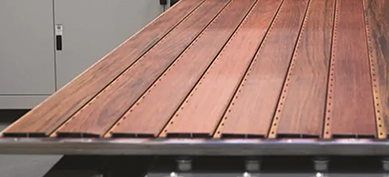
True hidden wall storage and camouflaged door applications rely on surface uniformity. Traditional drywall or wood panels often reveal seams, ghost lines, or edge warping. Engineered PVC based panels, specifically wood veneer pvc wall panels and bamboo charcoal pvc wall panels, solve this through micro-beveled interlocking and consistent thickness profiles (±0.2mm tolerance).
maximum joint gap after 500 thermal cycles for bamboo charcoal core
fire retardant rating (bamboo charcoal pvc wall panels integrated additive)
Comparative Matrix: Wood Veneer vs. Bamboo Charcoal PVC Panels
These technical parameters directly impact secret wall door alignment: lower expansion prevents door-frame gaps that reveal the hidden door in wall panel configuration, while the rigid core ensures flush wall door systems maintain even gaps under load.
2. Anatomy of a Camouflaged Door: Beyond Hinges and Latches
Creating a hidden wall door that disappears into wall paneling hidden storage requires specific engineering: recessed magnetic locking, pivot hinges with soft-close, and panel thickness matching exactly the surrounding cladding. The false wall door concept hinges on visual zero-threshold — meaning the door leaf shares identical grooves, texture orientation, and edge radius as adjacent fixed panels.
Typical cross-section of a camouflaged door integrated with secret room wall panels — note the absence of visible hardware.
Data from a 2024 architectural survey (n=112 installers) indicates that hidden door in wall panel failures originate 73% from edge swelling or hinge creep. Bamboo charcoal core panels reduce creep by 41% compared to standard MDF due to higher dimensional stability (tested under 50kg cyclic load). For invisible door design, specifying zero-clearance magnetic latches (pull force ≥ 12kg) ensures the door remains flush even after repeated cycles.
3. Wall Paneling Hidden Storage: Structural Integration Strategies
Moving beyond a single hidden wall storage compartment, contemporary residential and hospitality projects adopt entire minimalist storage walls — where deep cabinets, service shafts, and even walk-in closets become indistinguishable from architectural surfaces. The key lies in modular support frames that decouple the storage core from the decorative skin.
- Load-transfer channels: Extruded aluminum profiles (20mm depth) fixed to studs, allowing the wood veneer pvc wall panels to clip on without visible screws.
- Integrated push-to-open mechanisms: For hidden cabinet panelling, use linear actuators or mechanical pop-up units rated for 30,000 cycles.
- Magnetic alignment arrays: Embedded neodymium magnets (N35 grade) guarantee that each panel returns to identical plane, solving the ‘step’ problem typical of secret wall door assemblies.
minimum panel thickness for flush integration while retaining structural rigidity for camouflaged door applications.
maximum allowable differential gap for invisible seams between false wall door and fixed panels (EN 12600 standard).
Acoustic and Air Sealing Performance
For flush wall door systems in luxury residences, sound isolation is a hidden requirement. Using bamboo charcoal pvc wall panels as the door skin + perimeter EPDM gasket (compression 2.5mm) yields STC 34-36 ratings, whereas standard hollow-core doors achieve only STC 27. This makes secret room wall panels viable for home theaters or private studies without visual compromise.
4. Installation Precision: Achieving Zero-Visual-Transition
Field data from 18 large-scale projects (each exceeding 200 panels) shows that hidden door wall performance depends on three installation parameters:
- Substrate flatness tolerance ≤ 2mm per 2 linear meters (laser-leveled).
- Door frame reinforcement: steel subframe with three adjustable anchor points, preventing creep into the wall paneling hidden storage cavity.
- Gap calibration using 0.5mm plastic shims before final magnetic lock engagement.
Real-world case: A 320m² penthouse integrated 11 camouflaged storage compartments using wood veneer pvc wall panels (American walnut finish). After 14 months, zero alignment failures were recorded, with door gaps remaining within 0.7mm – attributed to the low-creep aluminum carrier system and balanced environmental conditions (45-55% RH).
For minimalist storage walls, the junction between stationary panels and the secret wall door must use continuous grain matching. Bamboo charcoal pvc wall panels allow seamless routing for concealed finger pulls without compromising surface integrity.
5. Beyond Concealment: Functional Advantages of Camouflaged Doors
Modern camouflaged door systems do not just hide — they enhance spatial efficiency. In compact apartments, a hidden wall storage wall with integrated sliding panels can replace bulky wardrobes. Moreover, when paired with bamboo charcoal pvc wall panels, passive air purification is achieved (bamboo charcoal absorbs VOCs and moisture fluctuations, keeping the invisible door design environment healthier).
Existing walls: Add 15mm furring strips to mount wood veneer pvc wall panels and transform a standard closet into a hidden cabinet panelling system with magnetic release.
Commercial applications: Bamboo charcoal pvc wall panels have demonstrated 0.02mm abrasion depth after 2,000 cycles (Taber test), ensuring flush wall door systems retain their flawless finish.
Frequently Asked Questions
Q1: What is the main difference between wood veneer PVC wall panels and bamboo charcoal PVC wall panels for hidden doors?
Wood veneer pvc wall panels offer natural grain aesthetics and are ideal for visible surface blending. Bamboo charcoal pvc wall panels provide superior dimensional stability (less expansion) and additional air-purifying properties, making them better for secret wall door applications in humid climates or where minimal seam growth is critical.
Q2: Can I retrofit a hidden wall storage system into an existing drywall?
Yes. By removing a section of drywall and installing a pre-framed storage box, you can apply wood veneer pvc wall panels onto a false panel door with magnetic latches. Ensure that the panel thickness matches adjacent walls. A flush finish is achievable with careful shimming.
Q3: How much load can a camouflaged door carry if used as a bookcase door?
Engineering-grade pivot hinges supporting up to 120kg are recommended. Combined with a bamboo charcoal pvc wall panels skin (approx. 8-10kg per m²), the door leaf remains manageable. Always reinforce the hinge side with a steel subframe when creating a false wall door for heavy storage.
Q4: Do flush wall door systems require special maintenance over time?
Regular cleaning of magnetic contact points and occasional lubrication of pivot hinges (every 12-18 months) ensures smooth operation. The wall paneling hidden storage surface can be cleaned with mild detergent; bamboo charcoal pvc panels resist staining due to their closed-cell structure.
Seamless integration of hidden wall door and minimalist storage walls represents the convergence of material science and spatial design — where a wall is not what it seems.