

 English
 Español
The Wall Material Market Is Changing: Why PS Panels Are Becoming the New Favorite for Contractors and Property Owners
For the past decade, wall material choices were simple: save money with latex paint, add style with wallpaper, waterproof with ceramic tiles, or go cheap and “water-resistant” with PVC panels. But every option came with a cost – peeling, mold, scratches, fire hazards, and frequent renovations.
Today, a material that is not entirely new but suddenly gaining traction – PS (polystyrene) wall panels – is spreading rapidly across residential renovations, rental properties, retail chains, and public buildings.
It is not perfect. But its strengths hit the pain points of traditional materials head-on: waterproof, impact-resistant, fire-safe, formaldehyde-free, and renovation without downtime.
This article examines, from a global sourcing perspective, the five core reasons behind the rapid growth of PS wall panels.
1. Fire Compliance: B1 Rating Becomes a Hard Requirement
In more and more countries across the Middle East, Southeast Asia, and Europe, fire ratings for interior wall materials are no longer “recommended” – they are mandatory. PVC panels are typically B2 or B3, releasing large amounts of black smoke and hydrogen chloride gas when burning – gases that are often more lethal than the flames themselves. Latex paint is combustible, and wallpaper is a fuel source.
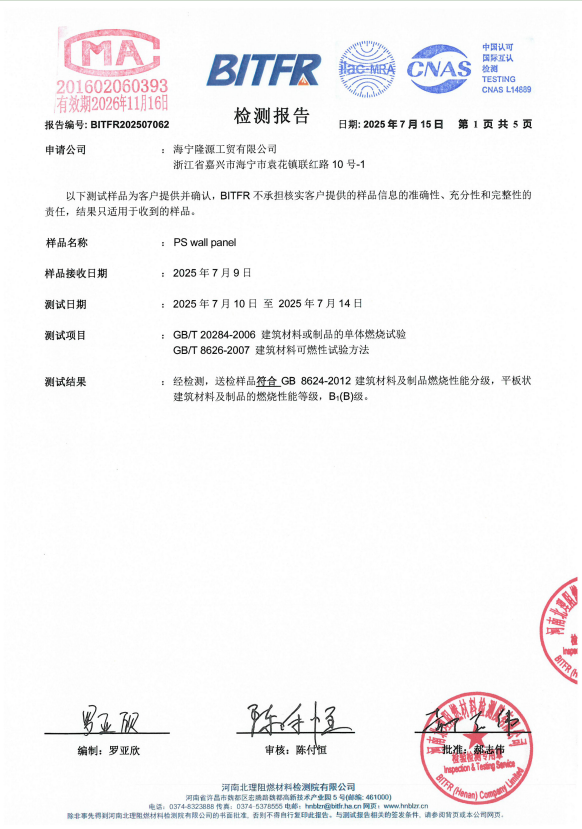
PS panels achieve B1 (difficult to ignite) under GB 8624 or EN 13501-1 – self-extinguishing, no flaming droplets, low smoke toxicity. This means:
Passing fire inspections – whether for hotels, schools, hospitals, or high-rise apartments, B1 is the baseline.
Lower insurance premiums – in some markets, using B1 materials qualifies for reduced fire insurance rates.
Avoiding legal liability – in a fire, non-compliant materials can shift major responsibility to the owner or contractor.
Example: A Philippine supermarket chain switched to PS panels for the fresh food sections across 40 stores after the local fire bureau explicitly required B1 rating. Their previous PVC panels were deemed a “safety hazard” and ordered removed.
2. Waterproof & Moisture Resistance: Not Just “Water-Resistant,” but Non-Absorbent
Many materials claim to be waterproof, but they are actually only water-resistant – water beads on the surface but over time, or through edges, it penetrates, causing swelling, mold, and detachment. Ceramic tiles themselves are waterproof, but grout lines turn black and harbor mold within two years.
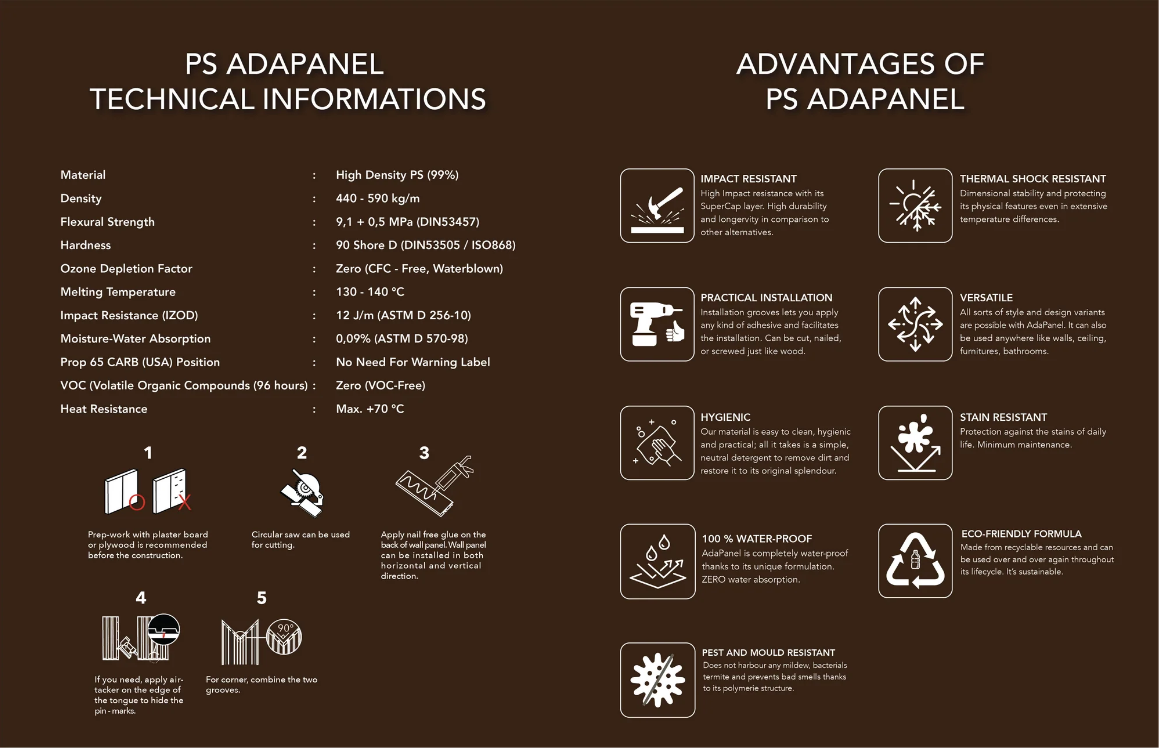
PS panels are fundamentally different: water absorption ≤0.5% (24-hour immersion test). It is not a surface coating that repels water – the material itself has a closed cell structure that water molecules cannot enter.
This makes PS panels suitable for:
Bathroom dry zones (vanity walls, toilet backsplashes)
Kitchen non-cooktop walls (grease and steam wipe off easily)
Basements, garages, storage rooms (perpetual dampness – no peeling)
Coastal apartments and high-humidity regions (no mold during rainy seasons)
Laundry rooms and pet areas (water and stain resistant)
And because they do not absorb moisture, mold has no environment to grow. No black spots on the back, no edge curling, no softening of the substrate.
3. Impact & Stain Resistance: No More “Annual Repairs” for Rentals, Kindergartens, Hospitals
Latex paint dents at the slightest touch. Wallpaper tears with a single scratch. PVC panels show white marks from a fingernail. For high traffic spaces, these materials require patching every year, and the cumulative cost is enormous.
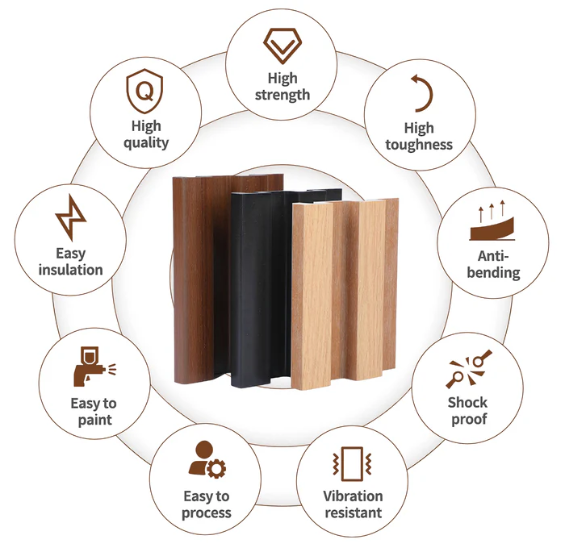
PS panels have surface pencil hardness HB-F – a key scrape leaves almost no mark. Impact resistance ≥10 kJ/m² – handcarts, suitcases, children’s toys cause no damage. Stains (soy sauce, grease, crayons, tape residue) wipe off with a damp cloth and mild detergent.
10-year maintenance cost comparison (20m² wall):
| Material | Initial cost (material + labor) | Redos in 10 years | Total 10-year cost | Maintenance effort |
| atex paint (hired) | ~$250 | 2-3 times | $750-1000 | High (major redo every 3-5 years) |
| Wallpaper (hired) | ~$300 | 1-2 times | $600-900 | Medium-high (curling, mold) |
| Ceramic tiles (excluding removal) | ~$400 | 0 (but grout needs care) | $450-500 | Medium (grout discolors, cracks) |
| Cheap PVC (DIY) | ~$350 | 1-2 times | $700-1050 | Medium (yellowing, brittleness) |
| PS panels (DIY adhesive) | ~$200-300 | 0 | $200-300 | Low (daily wipe) |
For landlords, kindergarten administrators, and hospital facility managers, PS panels mean no more annual headaches over walls.
4. Fast Installation + Zero Formaldehyde: Renovate Without Moving Out, Use Immediately
The biggest hidden cost of traditional renovation is moving out. Repainting: stripping, putty, sanding, primer, topcoat, ventilation – at least a week before a room is habitable. Wallpaper: 3-5 days, with strong adhesive odors.
With PS panels:
No need to remove old walls (old paint, old wallpaper, old tiles – all can be covered directly)
No professional tools or skilled labor required (adhesive method needs only a level, caulk gun, utility knife)
Dust-free, odor-free (cutting creates minimal dust; no paint fumes)
Finished in one day, usable the same day
Moreover, formaldehyde “not detected” (third-party tested). No need for ventilation. No respiratory irritation. This is especially critical for homes with pregnant women, infants, the elderly, as well as hospitals and kindergartens.
5. Global Certifications: The Passport for Export Procurement
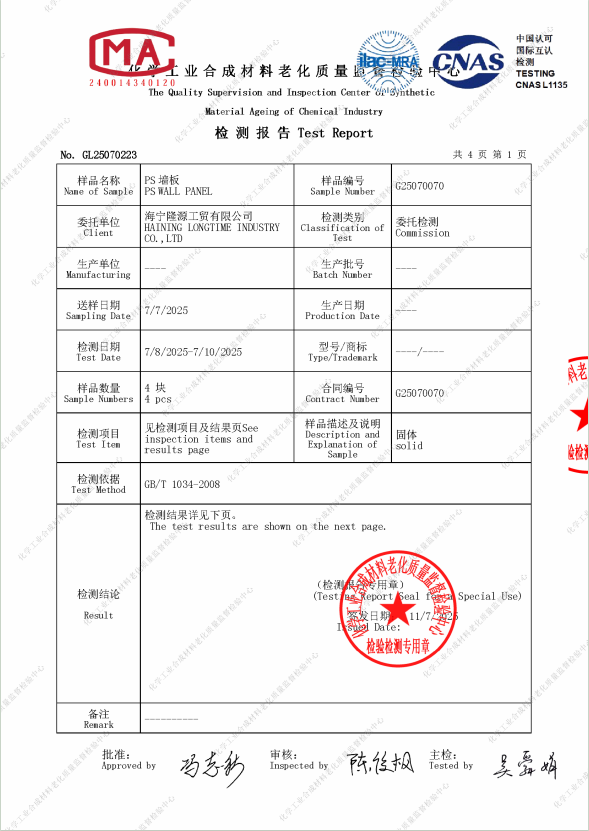
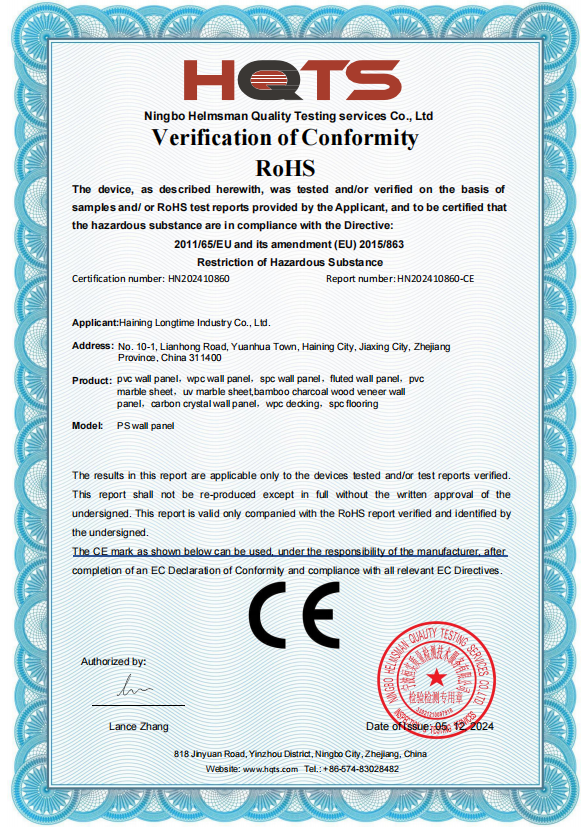
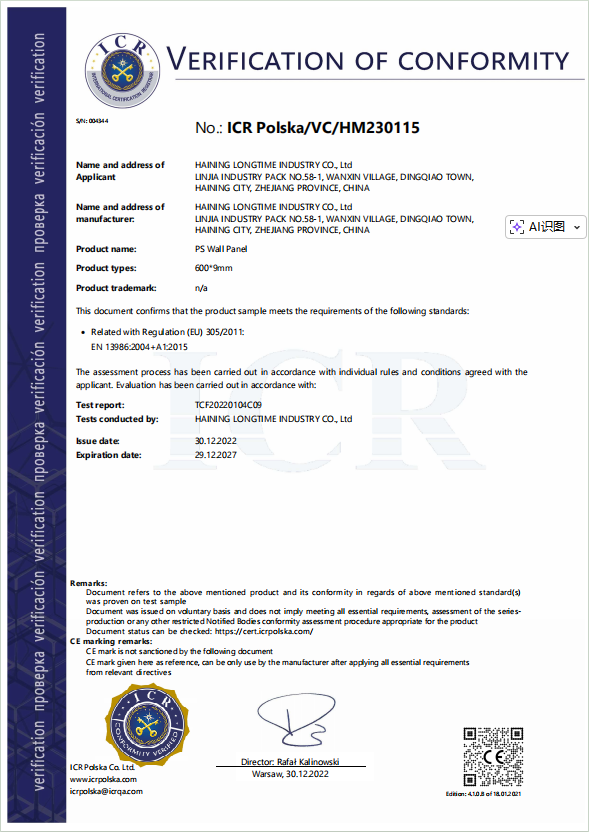
For exporters, importers, and international contractors, lacking proper certificates means disqualification from bids, customs holds, and failed inspections. PS wall panels come with a full set of certifications:
B1 fire report (GB 8624 / EN 13501-1)
Water absorption ≤0.5% test report (GB/T 24137)
CE certificate (EN 13501-1 + EN 717-1)
Formaldehyde “not detected” report (GB 18580 / EN 717-1)
These certificates mean the product can be legally sold and used in most markets – EU, Middle East (e.g., Saudi Saber recognized), Southeast Asia, Africa, and beyond.
A typical example: A Zhejiang exporter supplied PS panels to a Dubai contractor. The contractor demanded B1 fire report and CE certificate. Because the documentation was complete, the deal closed within a month. A competitor without EN-standard fire test reports was eliminated.
6.PS Panels Are Not Perfect – But Their Home Ground Is Large Enough
The limitations of PS panels should also be clearly stated:
Not for shower wet zones (long-term direct water spray – ceramic tiles remain the better choice)
Not for open outdoor walls (prolonged direct UV accelerates aging; enclosed balconies with light colors are fine)
Not for floors (not slip-resistant, insufficient thickness)
Textures are realistic but not genuine stone/wood (unless you demand natural authenticity)
But for all walls except wet zones, exteriors, and floors – PS panels offer a solution that balances safety, durability, aesthetics, economy, and convenience. From homeowner renovations and rental makeovers to retail chains, office buildings, hospitals, schools, and hotels – the applications are far wider than you might think.
7.Product qualification
Frequently Asked Questions
- Where is your factory located?
NO.10-1 LIANHONG ROAD, YUANHUA TOWN, HAINING CITY, ZHEJIANG PROVINCE, CHINA. - Can PS panels be used behind a kitchen cooktop?
Not recommended. Temperatures near a cooktop can exceed 100°C with potential direct flame or splashing hot oil. Use ceramic tiles or stainless steel. - Are PS panels cost-effective for rental properties?
Very much so. Material cost is moderate, DIY installation saves labor, and no repairs are needed for a decade. Between tenants, a damp cloth makes the walls look brand new – no security deposit deductions and no redo. - What is the main difference from PVC panels?
PS has higher hardness (HB-F vs ≤2B), better fire rating (B1 vs B2/B3), better aging resistance (no yellowing for 5 years vs 2 years), and zero formaldehyde (PVC often uses lead stabilizers and plasticizers). Slightly higher upfront cost, but lower total cost over time. - Can you provide samples for testing?
Yes. Small samples can be sent for you to conduct your own burn, soak, and scratch tests.
For samples, quotations or technical specifications, please contact:
Haining Longtime Industry Co., Ltd
Official website: https://www.longyuanpanels.com/
WhatsApp: +86 173 7761 1682
Email: [email protected]
Samples Policy: We provide samples, catalogues and fastener demonstration units free of charge; shipping costs are payable on delivery.