

 English
 Español
From Tropical Rainforests to Desert Climates: How PS Wall Panels Perform Across the World‘s Most Demanding Environments
Building material performance is never absolute. The same product that works perfectly in Norway’s dry cold may fail within a year or two in Indonesia’s humid heat. This is why international sourcing goes beyond looking at samples – you must understand how a material withstands the specific climate of your target market.
PS wall panels have been widely adopted in recent years across vastly different climate zones – the Middle East, Southeast Asia, Europe, Africa. What makes them so adaptable across such a broad range of environments? This article examines four typical climate scenarios, supported by test data, to break down the cross-climate adaptability of PS wall panels.
1. Humid Tropical Climate (Southeast Asia, South America, Southern China)
Representative markets: Indonesia, Philippines, Brazil, Thailand, Guangdong/Hainan (China).
Key challenges: Relative humidity often exceeds 80% year-round. Walls are constantly exposed to moisture. Latex paint peels, wallpaper molds, PVC panels develop black spots on the back, ceramic tile grout turns black or even falls out.
PS panel performance:
- Water absorption ≤0.5% – the material itself does not absorb moisture, no swelling, no softening.
- Non-porous surface – no place for mold to attach.
- Tongue-and-groove joints are tight – moisture does not easily penetrate the back.
Real example: A Singapore youth hostel chain installed PS panels in guest rooms and corridors in 2019. Four years later, no mold, no edge curling, no discoloration. A sister branch that used PVC panels showed visible mold on the back of corridor panels after two years, and some joints had blackened.
Sourcing advice for humid tropics: Choose light-colored PS panels with UV protection (even indoors, UV through windows accelerates aging). A bead of waterproof caulk at joints adds extra moisture protection.
2. Hot & Arid Climate (Middle East, North Africa, Australian Outback)
Representative markets: Saudi Arabia, UAE, Egypt, Libya, Central Australia.
Key challenges: Outdoor temperatures often exceed 40°C. Indoors, air conditioning maintains 22-25°C, but wall surfaces near windows can exceed 50°C. Large thermal expansion and contraction demands high dimensional stability. Also, UV radiation is extremely strong – ordinary plastics yellow and powder within two years.
PS panel performance:
- Coefficient of thermal expansion 6-8×10⁻⁵/°C – much lower than PVC (≈15×10⁻⁵/°C). Stable in air-conditioned interiors – no seam gap issues from day-night temperature swings.
- Heat deflection temperature 70-80°C – window-adjacent wall surfaces at 50°C are well within the safe range.
- UV-resistant top layer – indoor use ΔE < 2 over 5 years (no visible yellowing). For areas near windows, light colors are recommended; dark colors may fade slightly under prolonged direct sun.
Real example: An office building in Dubai renovated its corridors and elevator lobbies in 2020 using light-colored stone-look PS panels. Three years later, no visible yellowing, joints still tight, none of the edge curling common in PVC panels.
Sourcing advice for hot arid climates: Request UV aging test reports (ΔE value) and confirm dimensional stability data at temperatures typical for summer window-adjacent walls in the destination market
3. Cold / Temperate Climate (Northern Europe, Canada, Northern Russia)
Representative markets: Norway, Sweden, Canada, Russia, Northeast China.
Key challenges: Indoor heating in winter makes air dry, but areas near exterior walls may develop condensation due to insufficient insulation. Materials must not become brittle at low temperatures (e.g., during transport or storage). Also, short renovation seasons require fast installation.
PS panel performance:
- Low-temperature toughness – PS remains adequately tough down to -20°C, unlike PVC which becomes brittle and cracks.
- Condensation tolerance – extremely low water absorption means occasional condensation does not penetrate or cause mold.
- Fast installation advantage – can be applied directly over old walls without stripping, putty, or drying. Avoids construction delays in cold weather.
Real example: A home owner in Montreal, Canada, used PS panels for his basement home theater walls. The basement is dry in winter and occasionally humid in summer. Two years later, no deformation, no joint gaps from humidity changes. He had previously painted the basement twice – each time it began peeling within a year.
Sourcing advice for cold climates: Request low-temperature impact test data (e.g., drop-ball impact at -10°C or -20°C). For installation, the nail-on method is recommended (adhesive cures slowly at low temperatures).
4. Coastal / Salt Spray Climate (Islands, Coastal Cities)
Representative markets: Philippine islands, Maldives, Florida, Hainan (China), Mediterranean coast.
Key challenges: High airborne salt levels, high humidity, and potential typhoons / heavy rain. Ordinary metal accessories corrode. Ordinary wall panels experience accelerated aging and surface flaking due to salt spray.
PS panel performance:
- The material itself is salt-spray resistant (polystyrene has no reaction to salt spray); surface coating must have good adhesion.
- Excellent waterproofing – incidental water ingress from wind-driven rain does not damage the wall.
- No metal content – no discoloration from salt corrosion.
Real example: A beachfront guesthouse in Sanya, Hainan, replaced bathroom dry-zone walls with water-terrazzo-look PS panels in 2021. Two years later, walls were intact, no surface powdering or discoloration from salt spray. Previously, latex paint required repainting every year.
Sourcing advice for coastal projects: Request salt spray test reports (e.g., GB/T 10125 or ASTM B117). Also specify stainless steel or anti-corrosion treated accessories.
5. Summary Table: PS Panel Suitability by Climate
| Climate Type | Representative Regions | Main Risks | PS Panel Performance | Special Considerations |
| Humid tropical (year-round high humidity) | SE Asia, South America | Mold, swelling, adhesive failure | Excellent (≤0.5% absorption) | Add waterproof caulk at joints |
| Hot arid (high temp + strong UV) | Middle East, North Africa | Yellowing, thermal expansion | Good (needs UV layer) | Light colors, avoid direct window sun |
| Cold (low temp + condensation) | Northern Europe, Canada | Brittleness, condensation | Excellent (tough to -20°C) | Use nail-on method; request low-temp impact data |
| Coastal / salt spray | Islands, coastal cities | Salt corrosion | Excellent (salt-spray resistant) | Stainless steel fasteners; request salt spray report |
| Temperate (four seasons) | Inland Europe, most of US | Humidity / temperature swings | Excellent | Standard installation works well |
6. Why Can PS Panels Adapt Across Climates? Technical Reasons
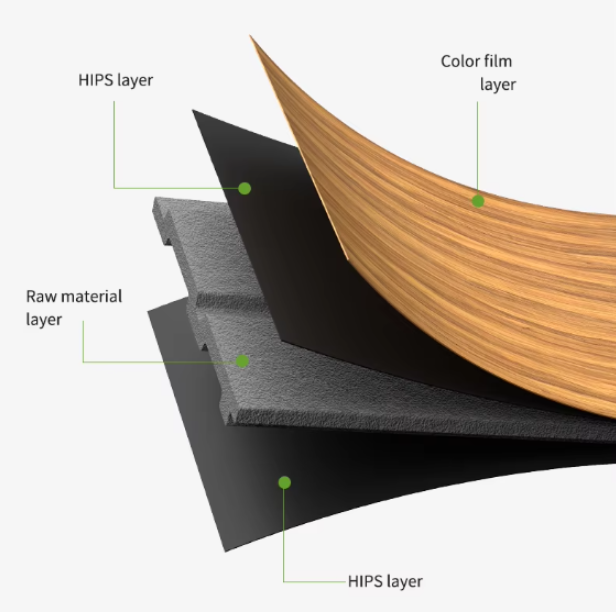
- Closed-cell structure
PS material has a closed-cell foam-like structure (even though it appears visually dense). Water molecules cannot enter – the fundamental reason for low water absorption and mold resistance. - Low coefficient of thermal expansion
About 40% lower than PVC, and lower than some wood-plastic composites as well. This means in regions with large day-night temperature swings (deserts, high plateaus), PS panels do not repeatedly expand and contract to cause joint issues. - UV-resistant top layer
Quality PS panels have a co-extruded or laminated UV-absorbing layer that delays yellowing. Indoors, no color change for 5 years. Light-colored panels near windows hold up for about 3 years. - No plasticizers
PVC relies on plasticizers (phthalates) for flexibility, but these additives migrate and volatilize, causing the material to harden, yellow, and release odors. PS requires no plasticizers, giving it much better long-term stability.
7. Sourcing Advice: What Data Should You Ask For to Ensure Climate Suitability?
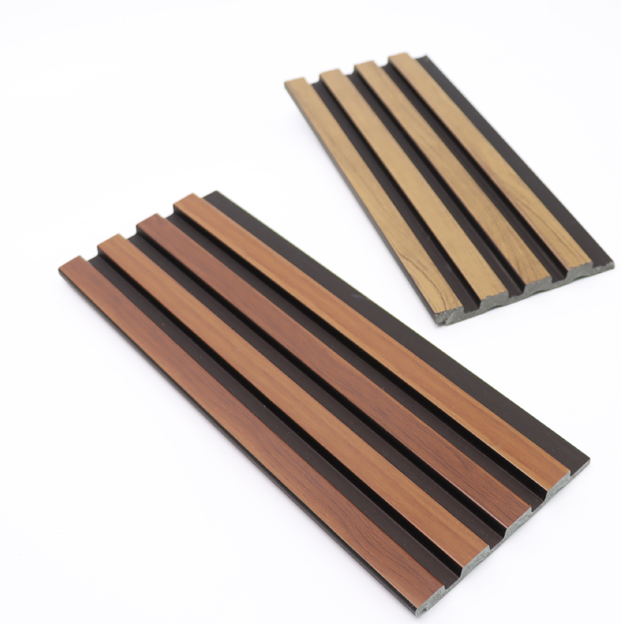
Depending on your target market climate, request the following test data from your supplier:
| Target Climate | Required Tests | Example Standards |
| Humid tropical | Water absorption, mold test (if available) | GB/T 24137, ASTM G21 |
| Hot arid | UV aging (ΔE value), heat deflection temperature | GB/T 16422, ASTM D4329 |
| Cold | Low-temperature impact (-10°C / -20°C) | GB/T 24137, ASTM D2794 |
| Coastal | Salt spray test | GB/T 10125, ASTM B117 |
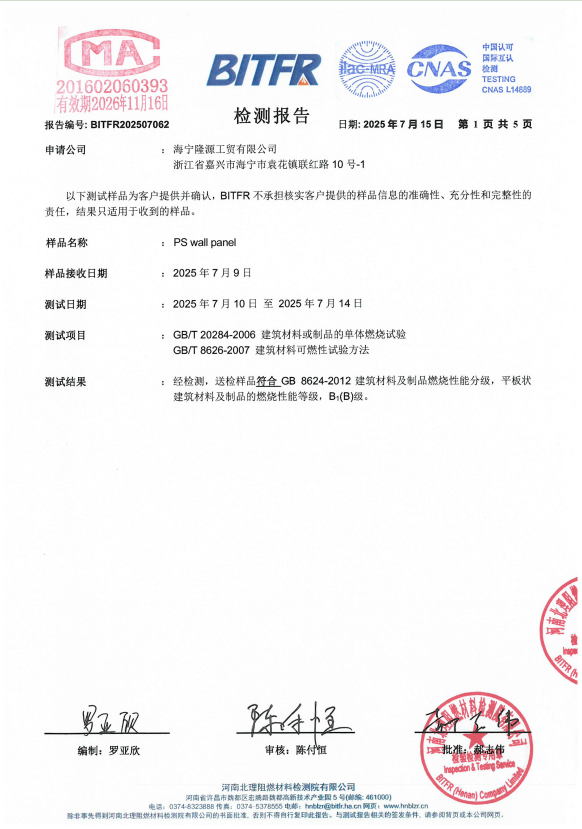
| Any market | Fire B1, formaldehyde not detected, CE | GB 8624, GB 18580, EN 13501-1 |
Without this data, your shipment may run into problems in the destination market – not because the product is defective, but because it is not suitable for that climate.
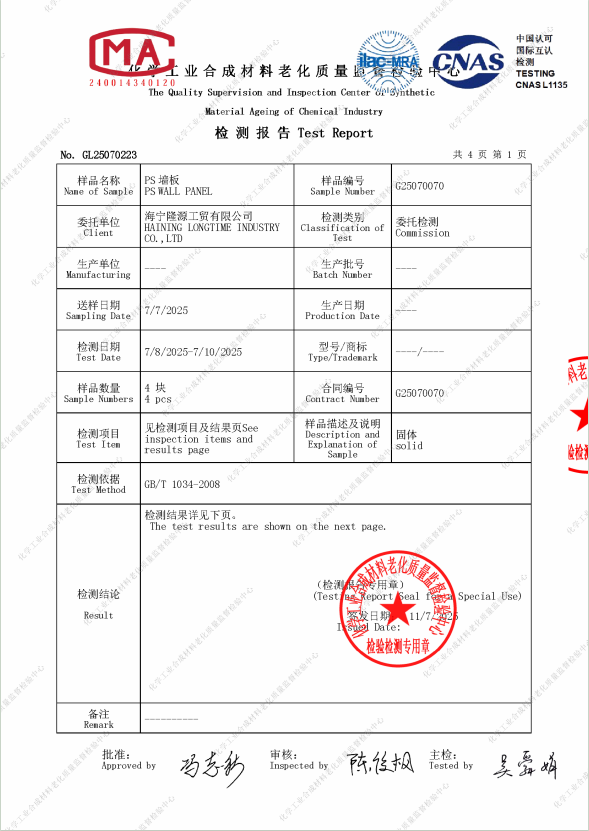
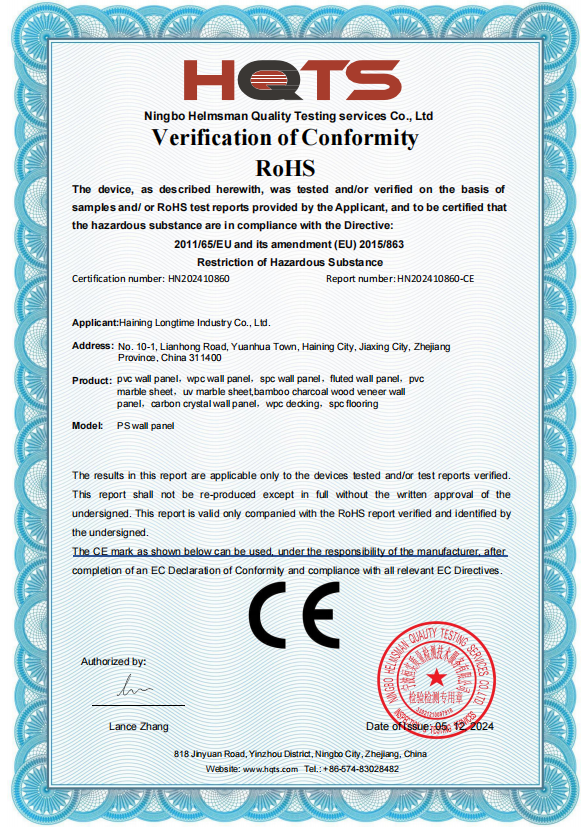
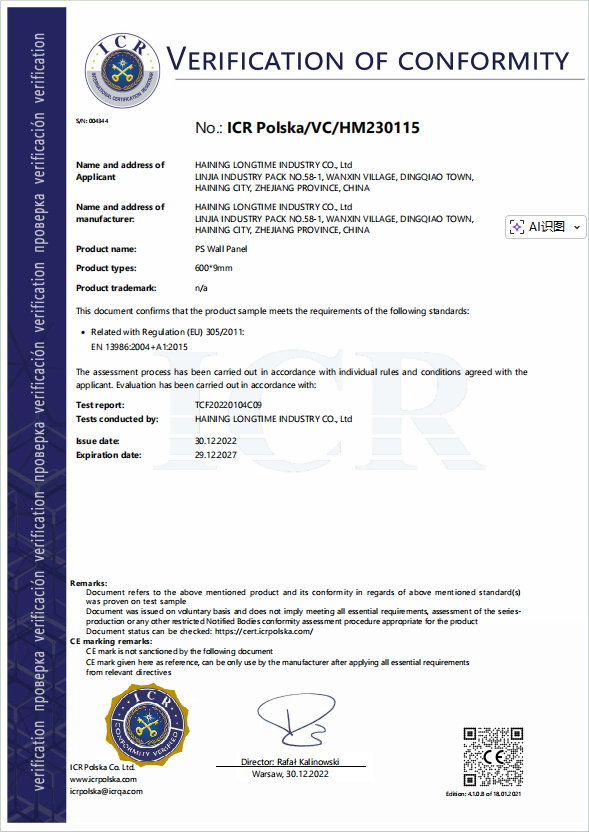
8.Product qualification
Frequently Asked Questions
- Where is your factory located?
NO.10-1 LIANHONG ROAD, YUANHUA TOWN, HAINING CITY, ZHEJIANG PROVINCE, CHINA. - Can PS panels be used in extremely cold regions (e.g., -30°C)?
Not recommended. PS maintains toughness down to -20°C. Below that, it may become brittle. For extreme cold, use specialized cold-climate materials or install PS panels on the interior side of insulation (not directly against freezing exterior walls). - Can dark-colored PS panels be used in coastal projects?
Yes, inside enclosed balconies or fully indoor spaces. For open, semi-exposed areas, dark colors may show slight fading over time under combined UV and salt spray. Light colors are recommended for coastal projects. - Does PS panel release harmful substances at high temperatures?
No. PS decomposes around 300°C. Normal indoor use (≤60°C) is completely safe. It does not produce dioxins, hydrogen chloride, or other highly toxic gases. - Can you supply custom formulations for specific climates?
Yes for bulk orders. For example, enhanced UV resistance or improved low-temperature toughness. Minimum quantity to be discussed.
For samples, quotations or technical specifications, please contact:
Haining Longtime Industry Co., Ltd
Official website: https://www.longyuanpanels.com/
WhatsApp: +86 173 7761 1682
Email: [email protected]
Samples Policy: We provide samples, catalogues and fastener demonstration units free of charge; shipping costs are payable on delivery.