

 English
 Español
Architectural Expressions: The Geometry of Linear Slat Paneling
Modern architectural surface design relies heavily on shadows, depth, and structural rhythm to convert flat planes into dynamic spatial features. Within contemporary luxury interior textures, the strategic deployment of three-dimensional surfacing has emerged as a fundamental methodology for manipulation of light and spatial scale. Linear geometries, specifically regular repetitive profiles, create a visual cadence that guides the eye, alters the perception of ceiling heights, and introduces acoustic diffusion properties to commercial and residential environments alike.
The selection between distinct surface textures requires an understanding of how micro-shadows behave across convex versus concave profiles. Specifiers, interior architects, and industrial designers frequently evaluate surface treatments based not only on material composition but on their interaction with directional lighting. By moving away from monolithic, untextured drywall and toward engineered dimensional surfaces, modern envelopes gain structural character and a heightened sense of craftsmanship without requiring historical masonry techniques.
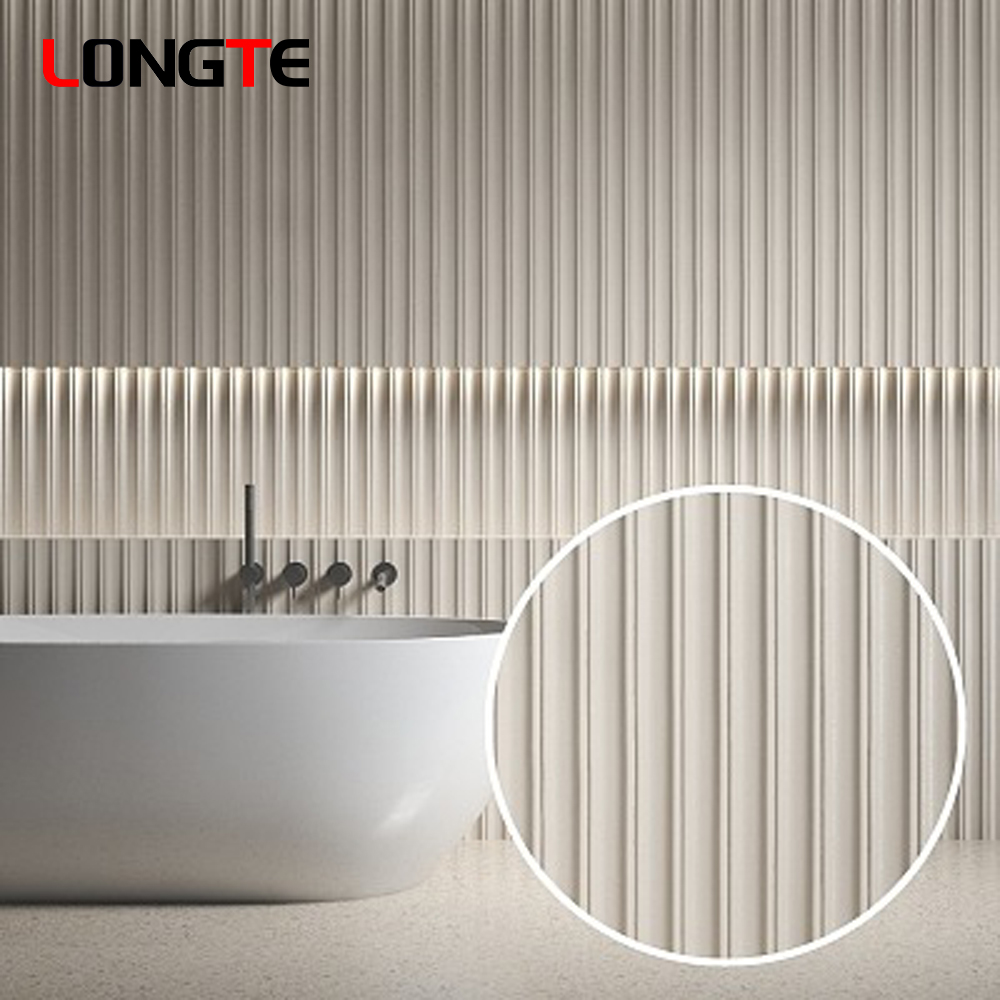
When developing a luxury surface strategy, design professionals analyze technical variables including depth-to-width aspect ratios, impact stability, moisture resistance, and installation efficiency. The evolution of manufacturing extrusion technology has enabled these sophisticated profiles to transition from rare, artisan-carved solid timber into highly stable, engineered architectural compositions. These modern systems offer predictable performance criteria, perfect dimensional tolerances, and integrated locking mechanisms that eliminate visible fastening hardware.
Reeded vs Fluted: Decoding Concave and Convex Architectural Details
In professional interior architecture, the terms describing linear ornamentation are often used interchangeably, yet they represent polar opposites in geometric construction. Understanding the structural divergence between reeded vs fluted geometries is vital for ensuring that the specified materials align with the intended aesthetic and lighting performance of the space.
A fluted wall configuration consists of a series of contiguous, rounded concave grooves carved or molded into the surface. Historically referenced from classical Doric and Ionic columnar architecture, fluting draws shadows into its deepest recesses, creating crisp, sharply defined vertical lines. Conversely, reeded wood wall panels feature a sequence of convex, rounded ridges that project outward into the room. Reeding mimics the natural clustering of organic reeds, yielding a softer, more pillowed texturing that catches highlight reflections along the apex of each curve.
The differences between these two profiles manifest directly across several key performance indicators. The following matrix details the specific behavioral and aesthetic criteria that separate the systems:
| Aesthetic and Structural Dimension | Fluted Wall Panelling | Reeded Paneling |
|---|---|---|
| Shadow Formulation | Concentrated, sharp linear shadows inside troughs | Dispersed, gradual gradients across ridge flanks |
| Primary Visual Accent | Emphasizes depth, negative space, structural lines | Emphasizes volume, tactile projection, material sheen |
| Tactile Footprint | Sinks away from the contact plane | Protrudes aggressively into the interior space |
| Historical Context | Classical Greek, Roman, and Mid-Century Modernism | Regency, Art Deco, and Neo-Classical detailing |
| Acoustic Scattering | Traps sound waves within internal cavities | Deflects sound waves over multi-directional apexes |
Choosing between a fluted media wall and a reeded statement partition depends heavily on the orientation of the primary illumination sources. When lit from the side by grazing light, a fluted profile generates high-contrast stripes, whereas a reeded surface creates a sequence of bright highlights separated by soft transitions, establishing a more delicate, ambient mood.
Material Composition Strategy: Polystyrene vs Wood-Plastic Composites
Beyond visual design, the longevity, physical durability, and application parameters of ribbed wall cladding are governed by material engineering. Modern projects have shifted from solid timber, which is prone to warping and requires extensive finishing, toward advanced polymers and composites. The two leading materials dominating this sector are Polystyrene (PS) and Wood-Plastic Composite (WPC).
High-density ps wall panel solutions represent an advancement in thermoplastic extrusion. PS panels are exceptionally lightweight, featuring a closed-cell structural core that renders them completely impervious to moisture and biological degradation. This makes them ideal for commercial environments that demand rapid installation cycles and cleanable surfaces. Their synthetic composition ensures zero VOC off-gassing when manufactured under proper quality controls, and allows for precise micro-embossing of realistic timber grains or metallic textures onto the outer surface film.
In contrast, engineered wpc wall panels combine natural wood fibers with thermoplastic polymers. This formulation delivers a robust cladding system that exhibits high impact resistance, a heavy solid-wood feel underfoot or to the touch, and superior dimensional stability over wide temperature variations. WPC is naturally suited for high-traffic public corridors, hospitality lobbies, and accent walls where physical durability is non-negotiable. The natural wood component provides inherent structural stiffness, minimizing the risk of deflection under heavy loads or unintended physical impacts.
High-Density PS Characteristics
- Weight Profile: Low density core, reducing shipping and wall dead loads significantly
- Moisture Rating: 100% waterproof, suitable for high-humidity washrooms and pool lounges
- Installation Method: High-tack polymer adhesive and fine-gauge brad nails
- Detail Crispness: Capable of micro-scalloped wall details and sharp edge radiuses
Engineered WPC Core Characteristics
- Weight Profile: High density composite weight, mimicking structural solid lumber
- Moisture Rating: Highly water-resistant, incorporating polymer-encapsulated wood fibers
- Installation Method: Stainless steel hidden interlocking clips screwed to studs or battens
- Detail Crispness: Excellent for bold 3D textured wall panels and robust exterior-grade profiles
When choosing between these substrates, the mechanical constraints of the site must take priority over purely visual preferences. For instance, an unheated coastal hospitality venue experiencing severe seasonal humidity swings requires the dimensional stability of WPC or the moisture immunity of PS, whereas a standard residential bedroom accent wall can leverage either material based entirely on color and grain preferences.
Illuminated Architecture: The Dawn of Luminous Grille Systems
The integration of lighting with architectural surfaces has evolved past simple surface-mounted fixtures and valence lighting. The introduction of luminous grille wall panels marks a fundamental shift, embedding lighting directly within the geometric profile of the wall paneling system itself.
These systems leverage specialized, translucent polymer compounds or hidden recesses within WPC/PS tracks designed specifically to accommodate low-voltage LED strip matrices. Instead of pointing light at a textured wall from an external source, the luminous grille acts as a self-contained light source. This structural integration eliminates unappealing hot spots and glare, distributing an even, diffused glow across the linear slat paneling, accentuating the vertical rhythm of the space.
From a practical application standpoint, luminous grilles change how corporate offices, luxury retail stores, and hospitality environments approach nighttime lighting. When integrated with smart dimming systems or automated building controls, these walls can transition smoothly from crisp daylight illumination to muted warm tones, reinforcing circadian rhythms while functioning as structural artwork.
Engineering Specifications and Installation Mechanics
Achieving a flawless, continuous installation with linear wood panels or synthetic alternatives requires adherence to strict engineering standards. Minor errors in wall leveling or adhesive distribution can quickly magnify down the line, resulting in misaligned joints or visible gaps that break the structural pattern.
The primary installation strategies rely on either hidden mechanical clips or high-performance elastomeric adhesives. The choice between these methods depends directly on the weight of the selected panel and the structural substrate of the wall. Review the standardized technical parameters below to ensure correct field execution:
| Technical Property | High Density PS Standard | Co-Extruded WPC Standard |
|---|---|---|
| Density Rating | Greater than or equal to 420 kilograms per cubic meter | Greater than or equal to 1200 kilograms per cubic meter |
| Thermal Expansion Coefficient | 3.5 multiplied by 10 to the power of negative 5 per degree Celsius | 2.1 multiplied by 10 to the power of negative 5 per degree Celsius |
| Substrate Requirement | Flat drywall, plywood, or level plaster surfaces | Timber framing, aluminum batten systems, or solid masonry |
| Joint Assembly Type | Overlapping shiplap with micro-mitred seam lines | Tongue and groove with internal fastener pocket |
| Fire Rating Class | Class B2 standard, upgradeable with additives | Class B1 flame retardant engineered core |
When managing an installation, teams must check that the underlying surface does not deviate by more than 2 millimeters over a 2-meter radius. If the surface exceeds this tolerance, installer teams must construct a leveling grid using wood or aluminum furring strips. Furthermore, allowing the panels to acclimate to the site temperature and humidity for 48 hours prior to installation is essential to prevent shifting or seam widening after mounting.
Frequently Asked Questions: Technical Clarifications
Q1: Can high-density PS wall panel systems be safely installed inside wet shower enclosures?
While high-density PS is entirely waterproof and will not support mold growth or suffer structural rot, it is not recommended for direct installation inside high-velocity shower enclosures unless the joint seams are sealed with industrial-grade waterproofing silicone compounds. For general washroom environments, accent vanities, and spa waiting rooms outside direct spray zones, it performs reliably without additional seals.
Q2: How do reeded wood wall panels behave regarding room acoustics compared to standard flat drywall?
Flat surfaces reflect sound directly, contributing to echo, flutter, and elevated reverberation times within a room. Reeded and fluted geometries act as natural diffusion surfaces. When sound waves strike the curved profiles, they break apart and scatter in multiple directions rather than bouncing cleanly back into the space. This scattering reduces harsh reflections, improving speech clarity and overall acoustic comfort.
Q3: What tools are required to cut WPC wall panels cleanly without chipping the finished edges?
WPC composite material contains a high proportion of natural wood fibers mixed with tough polymers, requiring sharp, stable cutting tools. To prevent edge melting or chipping, installers should use a circular miter saw fitted with a fine-tooth blade containing at least 80 to 100 teeth designed for laminate or non-ferrous metals. The panel should always be cut with its decorative finished face oriented upward to ensure a crisp, burr-free edge transition.
Q4: Are luminous grille wall panels field-serviceable if an internal LED driver or diode strip fails?
Yes, professionally engineered luminous grille systems are designed with a modular structure that separates the aesthetic face panel from the functional electrical track. Access panels or friction-fit diffusers allow maintenance teams to easily swap out low-voltage LED components, wiring harnesses, and controllers without destroying or dismantling the surrounding wall installation.
Q5: How should dust accumulation within a deeply recessed fluted media wall be managed over time?
Because fluted configurations contain deep concave recesses, dust naturally settles into the lower troughs over extended periods. Regular maintenance is straightforward, requiring either a vacuum cleaner fitted with a soft horsehair brush attachment or a standard micro-static duster. For public commercial spaces subject to high touch traffic, the panels can be wiped down with a damp microfiber cloth and a mild ph-neutral detergent solution; abrasive pad materials or harsh solvent cleaners must be avoided to preserve the finish integrity.