

 English
 Español

Two suppliers can quote the same PVC marble sheet and ship material that behaves differently on site. The gap rarely sits in the resin. It sits in the parts of the order nobody wrote down: film grade, topcoat, thickness tolerance, edge profile, packing.
What follows is written for importers, distributors and fit-out contractors who already know the category, and who would rather inspect a shipment against a written specification than argue about it three months later.
The three layers that decide how the sheet performs
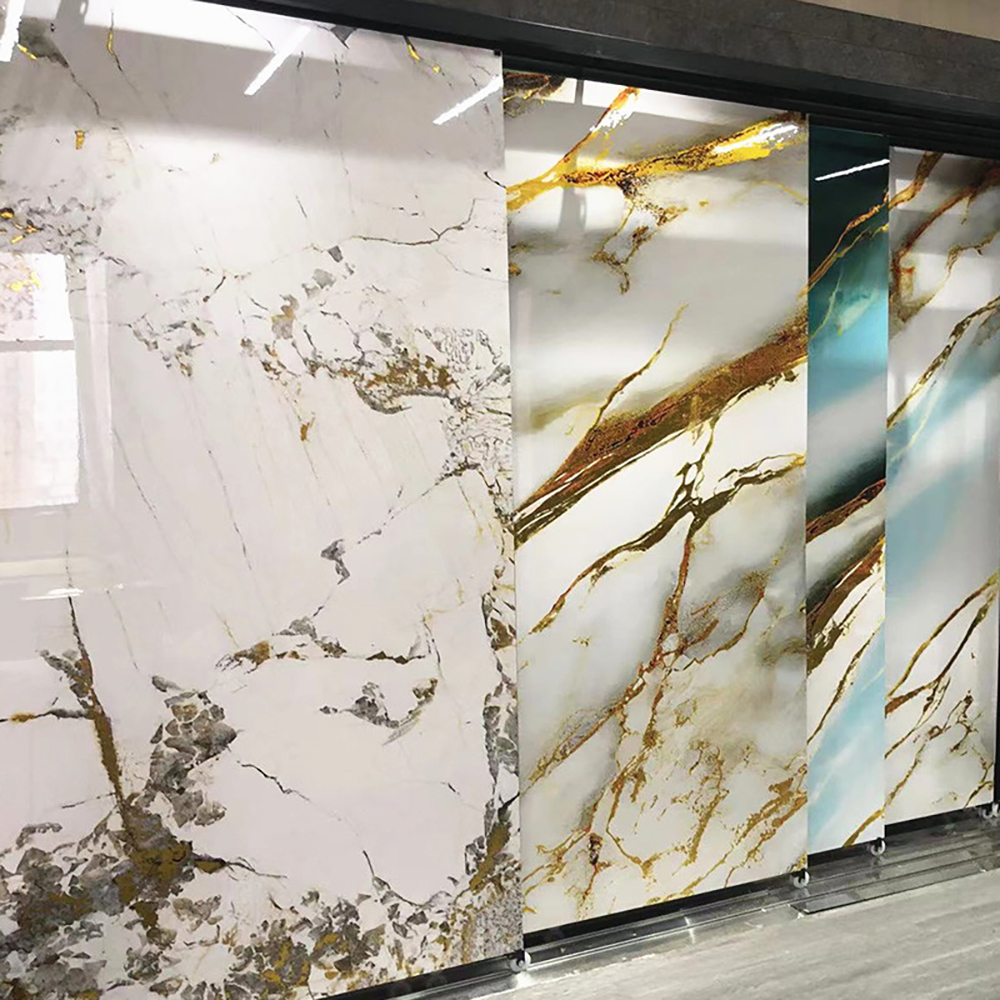
A PVC marble sheet is a three-layer build: a rigid PVC core, a printed decorative film, a UV-cured topcoat. Each layer can be written into a purchase order, and each one fails in a different way.
Core: weight, filler and flatness
The core is PVC compound with mineral filler, and the filler level drives weight, stiffness, and how the sheet holds a screw or an adhesive. Weight per square metre and core density are the two figures that let you compare two offers honestly. A heavier sheet is not automatically better, but an unexplained weight gap usually points to a different formulation, which tends to surface later as flatness drift or a changed feel under the screw.
Film: the layer buyers judge first
The film carries the marble look, so film weight, print method and pattern repeat length belong in the specification. Two checks need real sheets rather than renders: whether veins line up when panels sit side by side, and whether a design reordered months later still reads as the same design. Mismatched vein direction at a joint is the complaint that comes up most often in this product, and a catalogue page will never show it.
Topcoat: where vague claims hide
Gloss level, coat weight and cure quality decide how the surface survives cleaning, tape and site handling. When a finish is described as super scratch resistant with no test method attached, that is a design intention rather than a specification. It is reasonable to ask which test the factory runs and how often — steel wool rub, cross-hatch adhesion, solvent wipe. Not every supplier needs all three; you do need to know which one is behind the claim.
Thickness and tolerance: the number that needs a range
Nominal thickness tells you very little unless a tolerance travels with it. Worth writing down: the measuring instrument, whether readings are taken at the edge or the centre (it matters on extruded sheet), the permitted minus tolerance, sheet size and squareness, and how flatness is judged.
Consistency counts for more than the headline figure. Where panels butt together, a small step between two sheets reads as a hard shadow line under grazing light, and no amount of careful installation hides it. Measure a few sheets out of the carton rather than the sample bag; the carton is what your customer will open.
Surface, colour and light
Colour and gloss decisions made on a monitor do not survive a site visit. View the sheet in daylight and again under the warm lighting of a retail or hotel interior, at the angle where it will be seen. Texture depth and direction deserve the same attention: a stone texture running the wrong way across a joint is a permanent defect, not a shading issue.
One square metre assembled with the intended joint and trim settles more questions than a folder of photographs. Keep a retained sample from each batch, dated, with the batch code written on it. That habit alone removes most batch-to-batch disputes, because both sides end up arguing about a physical object instead of a memory.
Joints, substrate and site conditions
The panel is only one part of the system. Edge profile, substrate flatness, adhesive choice and trim detail decide whether the finished wall looks right.
- Square edge, or machined for a joint profile — and whether that profile is designed for adhesive fixing only.
- The substrate flatness the system expects, plus guidance for uneven plaster and board joints.
- Expansion allowance at perimeters and around openings.
- Availability of trims and corner pieces in the same finish, not a near match.
- Suitability for bathrooms and kitchen splashbacks, confirmed for the actual condition rather than covered by a generic waterproof claim.
Packing, pallets and container loading
Transit damage usually starts at a corner. Corner protection, interleaving, carton grade, pallet plan and the way mixed designs are stacked all belong in the order confirmation. A pallet carrying four marble designs has one design that gets crushed, and it is rarely the one you planned for.
Agree a photo protocol at loading and at unloading, with pallet numbers and carton counts visible. Container claims move much faster with that record than with correspondence written after arrival.
Approve a first article, not a catalogue
Panels pulled from a production run carry more information than samples assembled for a trade fair, so request production-representative sheets in the thickness and finish you intend to buy.
- Sign and date a master sample, and keep a duplicate.
- Have the supplier retain the same master against your item code.
- Require the batch code on cartons so a later complaint can be traced.
- Re-approve when the film supplier, core formulation or topcoat changes.
Eight questions for a first RFQ
- Film weight, print method and pattern repeat length.
- Topcoat type, gloss level, and the test method behind any surface claim.
- Nominal thickness with the permitted minus tolerance, and how it is measured.
- Sheet size, squareness, and the flatness criterion used at final inspection.
- Edge profile, and which trims ship in the same finish.
- Carton specification, pallet layout and corner protection.
- Minimum quantity per design, and a production lead time confirmed in writing rather than quoted verbally.
- Which changes force a new sample approval.
Where LONGTE fits
LONGTE is the brand of Haining Longtime Industry Co., Ltd., a PVC wall panel supplier based in Haining, Zhejiang. The range includes UV-coated PVC marble sheet alongside other interior wall finishes. The commercial approach is sample-first: physical panels and written product data before a production order, with OEM and private label terms agreed project by project.
Comparing PVC marble sheet suppliers gets easier once the specification does the work. Send the points above with your target thickness, finish, sheet size and volume per design, and ask for samples plus a written data sheet in return. LONGTE can answer at that level of detail, which is a more useful starting point than another folder of lifestyle renders.