

 English
 Español
When purchasing WPC wall panels, many people ask one question: what thickness should I choose? Common thicknesses on the market include 5mm, 7mm, 9mm, 12mm, 15mm, and even thicker. Different thicknesses have different prices, different performance, and different suitable applications. Choosing too thick wastes money; choosing too thin may result in insufficient strength.
This article explains in detail which thickness of WPC wall panels is suitable for which scenarios, and how to make the right choice based on your application.
1. The Relationship Between Thickness and Performance
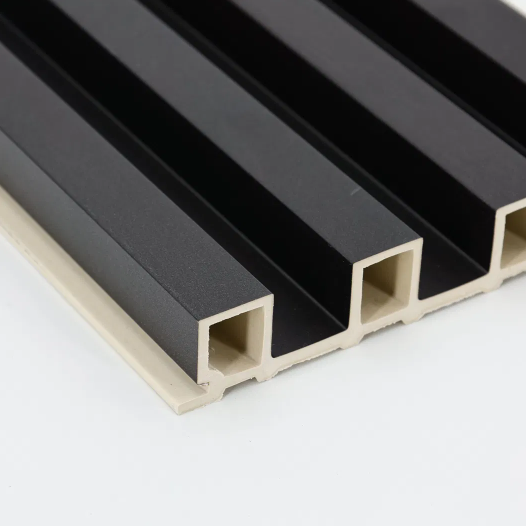
Thickness directly affects three key indicators: bending strength, impact resistance, and surface flatness.
Bending strength: The thicker the panel, the higher the bending strength. With the same furring strip spacing, thicker panels are less likely to bend or deform. Thicker panels can also support wider furring strip spacing, reducing the number of furring strips needed.
Impact resistance: Thicker panels better resist external impact. In high-traffic areas such as corridors and public spaces, thicker panels have a clear advantage.
Surface flatness: Thinner panels require higher substrate flatness. If the furring strips are uneven, thinner panels will more easily show the unevenness. Thicker panels have better inherent stiffness and can, to some extent, compensate for minor unevenness in the substrate.
Of course, increased thickness also means increased weight and higher price. A balance is needed.
2. Detailed Application Scenarios for Each Thickness
5mm
Characteristics: Lightest, thinnest, lowest price. Limited bending strength, higher requirement for substrate flatness.
Suitable applications: Feature wall decoration (TV wall, headboard wall, sofa background, etc., non-load-bearing walls). Dry indoor environments. Furring strip spacing not exceeding 40cm. Walls that are already relatively flat and do not require extensive leveling.
Not suitable for: Outdoor walls. Wet areas such as bathrooms and kitchens. High-traffic public areas. Large-span walls (furring strip spacing exceeding 50cm).
Recommendation: 5mm is the entry-level thickness, suitable for users with limited budgets who only want partial decoration. If conditions allow, at least 7mm is recommended.
7mm
Characteristics: One of the most commonly used thicknesses. Moderate weight, reasonable price. Strength and stability already meet most indoor requirements.
Suitable applications: Most indoor walls, including living rooms, bedrooms, studies, and offices. Furring strip spacing 40 to 50cm. Dry or moderately humid areas.
Not suitable for: Outdoor walls (without UV protection). Shower areas (wet zones). High-traffic public areas.
Recommendation: 7mm offers the best value for money as a general indoor thickness. If you have no special requirements, 7mm is almost always a safe choice.
9mm
Characteristics: Significant improvement in strength and stiffness, can support wider furring strip spacing (50 to 60cm). Better flatness, suitable for large-area full-wall installation.
Suitable applications: Large-space walls (full living room walls, large office walls). Projects with wider furring strip spacing. Scenes with high flatness requirements. Some commercial space walls.
Not suitable for: Outdoor walls (without UV protection). However, 9mm can already be used in any indoor area, including bathroom dry areas.
Recommendation: 9mm is the preferred indoor choice for quality and durability. If budget allows, 9mm is recommended for full-wall indoor installation.
12mm and above
Characteristics: High strength, high stiffness, high impact resistance. Suitable for walls requiring higher strength and stability. Higher price, with correspondingly increased weight.
Suitable applications: Outdoor walls (UV-resistant grade). Balconies, terraces, and other semi-outdoor areas. Basement moisture-proof walls. High-traffic commercial spaces (hotel corridors, restaurants, shopping malls). Walls requiring wide-span furring strip installation.
Not suitable for: Ordinary residential indoor walls (not cost-effective). Lightweight partition walls (weight may exceed the partition's load capacity).
Recommendation: 12mm and above is the standard choice for outdoor and commercial projects. At least 12mm for outdoor use, 15mm or above recommended for coastal or typhoon-prone areas.
3. Thickness Selection Decision Table
| Thickness | Suitable Applications | Furring Strip Spacing | Advantages | Disadvantages |
| 5mm | Indoor feature walls, partial decoration | ≤40cm | Lightest, cheapest | Moderate strength, high flatness requirement |
| 7mm | General indoor walls (living rooms, bedrooms) | 40-50cm | Best value for money | No outdoor capability |
| 9mm | Large full walls, high quality requirements | 50-60cm | Good strength, good flatness | Slightly higher price |
| 12mm+ | Outdoor, commercial spaces, high traffic | 50-60cm | Highest strength, most durable | Heaviest, most expensive |
4. Common Misconceptions About Thickness Selection
Misconception 1: Thicker is always better. Thickness is not necessarily better. For indoor scenarios, 5mm and 7mm already meet usage requirements, while 9mm meets the vast majority of needs. Blindly choosing thicker panels only adds unnecessary cost.
Misconception 2: Thin panels are of poor quality. 5mm and 7mm are not poor quality; they have different positioning. As long as they are used correctly in suitable scenarios, thin panels have no significant difference in lifespan compared to thick panels.
Misconception 3: Thick panels do not need furring strips. No matter how thick the WPC panel is, it requires furring strips or a flat substrate. Thickness only affects furring strip spacing; it cannot replace substrate treatment.
Misconception 4: Different thicknesses can be used in the same project. The same wall should use a uniform thickness. Different thicknesses will create height differences at the joints, affecting appearance.
5. Thickness Recommendations for Different Scenarios
Residential living room feature wall (partial decoration): 5mm or 7mm – the former is more economical, the latter more stable.
Residential full-wall installation (e.g., entire bedroom wall, full living room wall): 7mm or 9mm – 9mm recommended for better flatness.
Bathroom walls (dry area): 7mm or 9mm – 9mm recommended for more stable moisture resistance.
Shower area walls (wet zone): WPC panels are not recommended. Ceramic tiles or SPC panels are preferred. If WPC must be used, at least 9mm with all joints sealed.
Basement moisture-proof walls: 9mm or 12mm – furring strip installation with ventilation gaps recommended.
Balcony walls (semi-outdoor, sheltered): 9mm or 12mm – must be UV-resistant grade.
Villa exterior walls, building facades: 12mm or 15mm and above – must be UV-resistant grade.
Hotel guest room walls: 7mm or 9mm – 9mm recommended.
Hotel corridors, lobbies, and other high-traffic areas: 9mm or 12mm – must be UV-resistant grade (if exposed to natural light).
6. Frequently Asked Questions
Q: Can different thicknesses be used on the same wall?
A: Not recommended. Panels of different thicknesses will not be on the same plane, creating steps at the joints and affecting appearance.
Q: Does thickness affect waterproofing?
A: Not directly. The waterproofing of WPC panels depends on the material formulation, not thickness. 5mm and 12mm have the same waterproof performance.
Q: Does thickness affect sound insulation?
A: There is some relation. Thicker panels have greater mass, providing a slight improvement in sound insulation, but wall sound insulation mainly depends on the wall structure.
Q: Why choose 12mm or above for outdoor use?
A: Outdoor walls are affected by wind pressure, temperature differences, external impacts, and other factors. Panels of 12mm or above have better bending strength and impact resistance, ensuring long-term performance without issues.
Q: How to choose with a limited budget?
A: If budget is tight, choose 5mm for local feature walls and 7mm for main walls. Do not cut corners on bathrooms and outdoor areas – choose the appropriate thickness and grade.
7. Summary
The thickness of WPC wall panels should be chosen based on the application scenario, rather than blindly pursuing thicker. 5mm suits partial decoration, 7mm suits general indoor walls, 9mm suits large full walls and high-quality requirements, and 12mm and above suits outdoor and commercial projects.
If you are unsure which thickness to choose, 7mm or 9mm is the safest choice, covering the vast majority of indoor scenarios. For outdoor scenarios, at least 12mm is recommended.
For project-specific thickness recommendations, please contact us. We can also send samples of different thicknesses for you to compare before purchasing.
For samples, quotes or technical consultation, please contact:
Official Website: http://www.ltpvcfactory.com
WhatsApp: +86 17757302351
Email: [email protected]
Sample Policy: Free samples and brochures are provided, with freight collect.