

 English
 Español
It all started with an email last June.
Our (Haining Longtime Industry Co., Ltd.) export team received an inquiry from Tan, a Malaysian architect. The subject line was restrained but the content was resigned: "Penang hill villa – stone facade falling apart, need replacement light enough for hillside." He attached more than twenty photos: an ocean view villa halfway up Penang Hill, its exterior clad in locally sourced natural slate. In the photos, the stone showed extensive weathering and spalling, dark green moss had grown deep into the joints, and several slabs had even loosened and fallen off, exposing the blackened wall underneath.
Tan wrote in the email: "The owners, Mr. and Mrs. Lim, are from Penang. This villa was built twelve years ago. They chose natural stone because they thought it would be durable. But tropical downpours, high humidity, and salt spray have taken turns attacking it – the stone started failing before it even hit ten years. Last rainy season, a slab fell off the second-floor exterior and smashed a flower pot below. Luckily it didn't hit anyone. They're afraid to walk near the walls now."
After reading the email, I knew exactly what Tan was up against. Penang is tropical – high temperatures and heavy rain year-round, relative humidity often above 80%, plus salt spray and hill winds at mid-mountain level. This environment is a brutal test for any exterior material. Tan later told me that he had drawn up a simple table for the Lims, laying out the pitfalls upfront:
| Material Option | The Lims' Concern | Tan's Field Experience |
| Natural slate (one more replacement) | Already burned once, don't want a second | Natural stone absorbs water in tropical climate – moss grows, temperature fluctuations cause spalling |
| Cultured stone (cement-based) | Worried texture won't match a ocean view villa | Repetitive texture, uniform color – looks factory-made up close, also absorbs water |
| Stone-look coating (spray-on) | Afraid it will crack and peel within years | Tropical sun + rain cycles shorten coating life even more |
| PU stone (polyurethane imitation stone) | Can it survive tropical climate? Is the texture natural? | Tan had seen samples in Kuala Lumpur but never used it in Penang |
In other words, before contacting us, the Lims and Tan had already looked into every possible option. The conclusion was consistent: either it can't handle tropical climate, or the texture is wrong, or both. Tan's email carried a sense of "one last try."
Samples, Doubts, and a Video
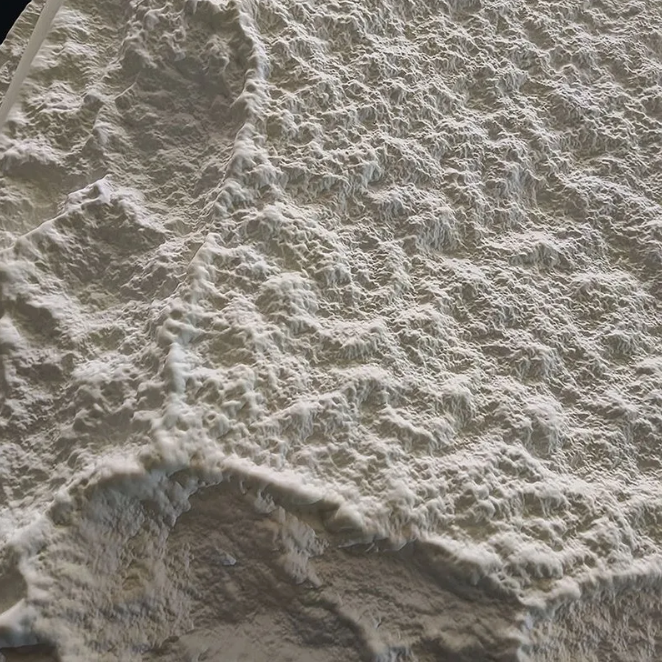
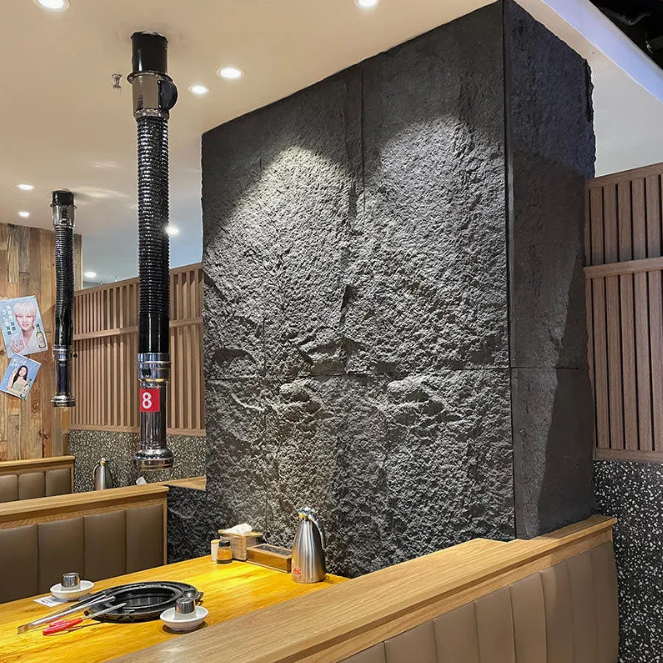
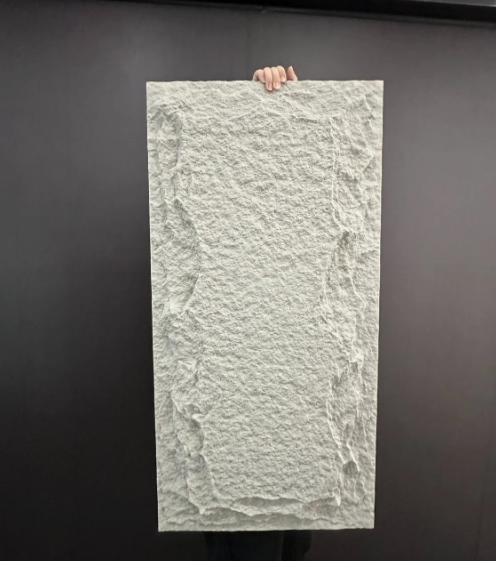
We sent Tan samples of our LT-PU-Stone slate series in dark grey, featuring the characteristic layered texture and rough surface of natural slate, size 600×1200mm. Three weeks later, he messaged us saying the Lims had placed the samples next to the stone path in their garden, comparing them side by side with the original natural slate, and let them weather a week of afternoon thunderstorms.
Mr. Lim's exact words, relayed through Tan: "Rain hits the surface and beads right off – it doesn't soak in like the original slate. The texture is three-dimensional too – it feels rough like stone. But in Penang, it rains every afternoon and the sun comes out right after – can you guarantee it won't crack in five years?"
Facing this practical question, we didn't send a lab report. Instead, we pulled a real installation video from our factory archive – the same series of PU stone installed in 2019 at a beachfront resort in Phuket, Thailand, shot in June 2025, six years after installation. The wall had endured six tropical rainy seasons. The color had mellowed slightly compared to new, but the stone texture was intact – no cracking, no peeling, and the joints remained solid.
Mr. Lim's response: "If it survives Phuket, it survives Penang." We all breathed a sigh of relief on our end.
An Incident That Surprised Tan During Installation
The ocean view villa required 85 square meters of exterior wall renovation, including the main building and some local patching. Tan's crew planned to finish in five days. Here's the actual timeline:
| Day | Work Content | Time / Notes |
| Day 1 | Clean loose old stone, repair substrate, apply waterproofing | Completed as planned – more loose stones than expected |
| Days 2-3 | Layout marking, apply structural adhesive, install PU stone | Ahead of schedule – peak day reached 22㎡ installed |
| Day 4 | Continue installation, handle window openings, corners, and trims | All smooth |
| Day 5 | Final inspection, grouting, cleaning, final walkthrough | Passed |
Tan called on the evening of Day 3, clearly surprised: "This stuff goes up way too fast. My guys expected to level each piece one by one like real stone and wait for cement to dry. Instead, just apply structural adhesive, press it onto the wall, and it's done. One person installed nearly 22 square meters in a day. And no demolition needed – direct overlay on the old wall saved us a ton of trouble."
PU stone requires no demolition of old stone, no cement curing time, no heavy machinery. Apply structural adhesive in dots on the back of the PU stone on a flat substrate, and press it onto the wall. One person can handle the entire job. And since PU stone weighs only about one-tenth of natural stone, the old wall required absolutely no reinforcement.
What surprised Tan even more was the cutting. "You can cut it with an ordinary handsaw – clean edges, no need for water jets. Working halfway up a hill without heavy equipment on site – that's critical."
What Exactly Were the Specs of the PU Stone They Chose?
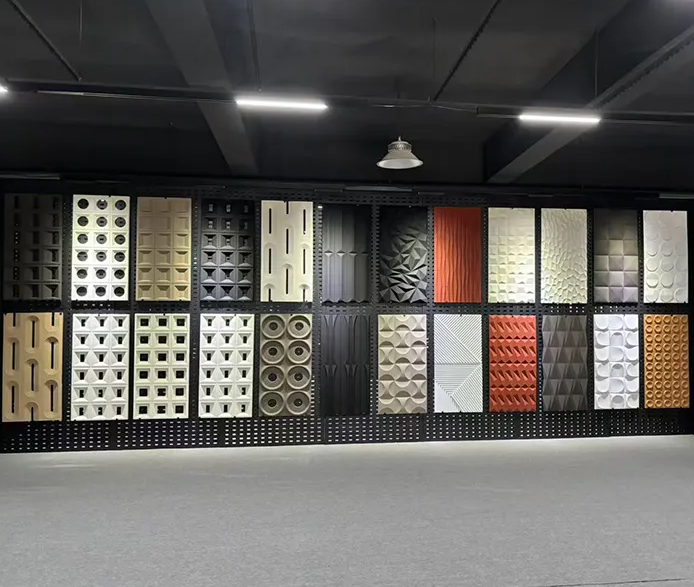
The model is our LT-PU-Stone slate series in dark grey. When communicating with Tan, I picked four points most relevant to his project:
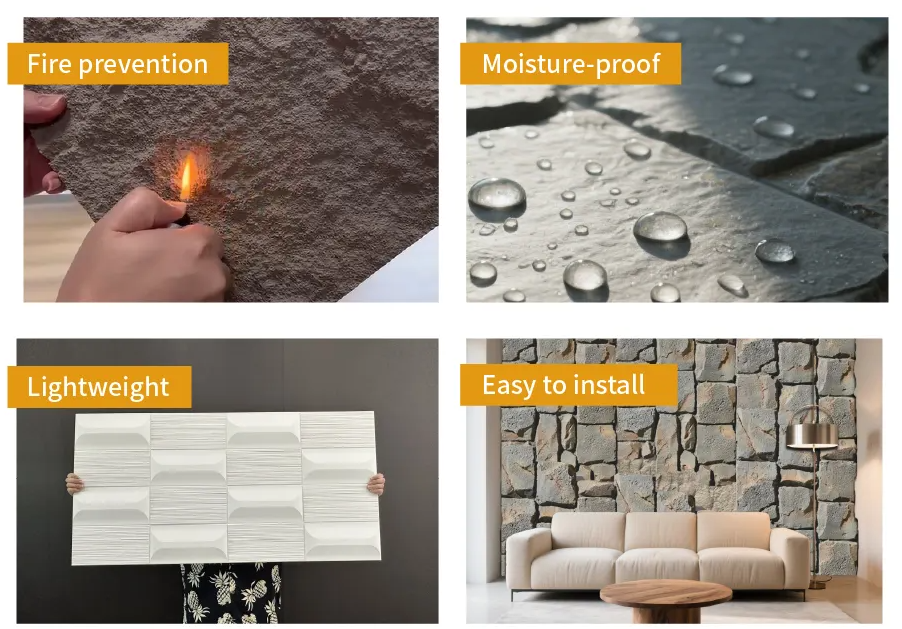
- Weight: only about 5 kg per square meter.Natural slate weighs 25-30 kg per square meter – PU stone is only one-fifth to one-sixth the weight. Heavy equipment can't access the mid-level of Penang Hill – this weight means one person can carry and install it without any mechanical assistance. The old wall required absolutely no reinforcement.
- Water absorption: 0.05%-0.1%.Natural stone typically has water absorption of 2%-5% – PU stone absorbs only one-thirty-eighth of what natural stone does. In Penang, it rains every afternoon. Water beads up and rolls right off the PU stone surface – it simply doesn't penetrate. That means no moss, no mold, no freeze-thaw spalling.
- Weather resistance: 6 years of real-world validation + UV-resistant coating.The Phuket video we sent Tan was the best proof – six tropical rainy seasons, no cracking, no peeling. PU stone has a UV-resistant coating that maintains over 95% of its original color after over a decade of direct sun exposure. Tropical UV has limited effect on it.
- Installation method: direct overlay, no demolition required.PU stone is bonded directly onto the old wall with structural adhesive – no need to remove the existing natural slate. No demolition = no debris = no noise = no waiting.
Full specifications are as follows:
| Parameter | Value | Plain English Translation |
| Material | High-density polyurethane + weather-resistant surface layer | Rigid polyurethane, not foam |
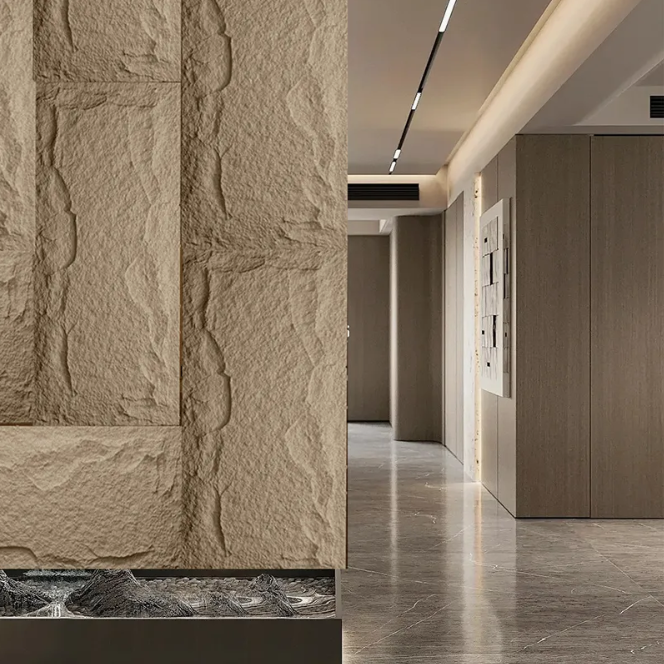
| Texture | Slate grain, dark grey | Molded from real stone, 3D texture |
| Dimensions | 600×1200mm | Large panels, fewer joints |
| Unit weight | Approx. 5 kg/m² | 1/5 to 1/6 the weight of real stone – one person can easily carry it |
| Installation method | Structural adhesive bonding | No cement, no demolition, no reinforcement |
| 24h water absorption | 0.05%-0.1% | Rain can't penetrate – moss can't grow |
| UV resistance | Weather-resistant surface layer + UV inhibitors | Tropical sun won't cause significant fading |
| Fire rating | B1 grade, self-extinguishing | — |
| Factory warranty | 10 years (non-load-bearing walls) | — |
Three Options, One Table – The Total Cost Breakdown
Tan later told me that the Lims' final decision wasn't because of any single impressive feature. It was because they laid out the total cost of all three options on the table and did the math:
| Comparison | Haining Longtime PU Stone |
Natural Slate (Replacement) |
Stone-Look Coating (Spray-on) |
| Weight (kg/m²) | 5 | 25-30 | <1 |
| Construction time (85m²) | 5 days | 14-21 days | 7-10 days |
| Demolition required | No – direct overlay | Yes – demolition + removal | No – direct spray |
| Structural reinforcement required | No | Yes | No |
| Water absorption | 0.05%-0.1% | 2%-5% |
— |
| Moss/mold risk | Very low | High | Medium |
| Texture realism | Molded from real stone, 3D texture | Natural texture, but will weather | Flat coating, no three-dimensionality |
| 20-year maintenance cost | Almost zero | Requires periodic sealing, replacement of loose stones | Requires recoating every 5-8 years |
| 20-year total cost | Medium-high initial + zero maintenance = Best value | High initial + ongoing maintenance = Highest cost | Low initial + periodic recoating = Hidden high cost |
| Best for | Tropical villa owners who want zero worry and do the math | Owners pursuing ultimate natural beauty and willing to maintain | Budget-limited projects accepting periodic maintenance |
Tan's exact words: "Penang has over two hundred rainy days a year. Before, the Lims worried about the exterior every rainy season – they wouldn't even park their car near the wall when it rained. Now with PU stone installed, a whole week of downpours and the wall doesn't change at all. Lim told me he can finally sit in his living room and watch the sea in the rain without worrying."
Mr. Lim Sent a Photo Later
In May this year, Penang entered its monsoon transition period. Mr. Lim sent a photo – the villa's new stone wall glowing dark grey in the sun after a tropical downpour, with the Penang Strait a deep blue in the distance. He added a caption: "Three months of monsoon rains. Not a single crack. Not a single moss spot. My wife finally stopped asking me to check the walls every time it rains."
For those of us in the building materials business, receiving feedback like this feels better than getting an order.
It also confirmed one thing for us: in Southeast Asia's tropical climate – heat, humidity, downpours, and sun all combined – the real value of PU stone isn't about saving money. It's that it makes a house truly belong to its owner, not to the weather.
If You're Also Tired of Exterior Maintenance in Tropical Climates
We don't rely on sales pitches. We recommend getting samples to see, touch, and spray with water for a few days yourself. That's how Mr. Lim was convinced.
Haining Longtime Industry Co., Ltd. has been manufacturing PU stone and related decorative materials for over 10 years, exporting to more than 40 countries worldwide, including Malaysia, Thailand, Singapore, Indonesia, the Philippines, and other Southeast Asian markets. Our factory is located in Haining City, Zhejiang Province, China.
Tell us where your project is, what your local climate is like, whether it's by the sea or in the hills, and what stone texture and color you're looking for. We'll match the right style based on your actual situation.
- For PU stone samples, color swatches, or installation drawings, email our export team directly with "Tropical Facade Inquiry" in the subject line. We'll reply with specific selection recommendations within 24 hours.
- Or visit our website at http://www.ltpvcfactory.comto submit your project information online.
For samples, quotes or technical consultation, please contact:
Official Website: http://www.ltpvcfactory.com
WhatsApp: +86 17757302351
Email: [email protected]
Sample Policy: Free samples and brochures are provided, with freight collect.