

 English
 Español
It all started with an email in February this year.
Our (Haining Longtime Industry Co., Ltd.) export team received an inquiry from David, an Australian builder. The subject line was direct: "Coastal cladding – sick of painting every 2 years." He attached more than a dozen photos: a beachfront villa on the Mornington Peninsula in Melbourne, its exterior timber in terrible condition. Paint was peeling off in large sheets, black mold had grown deep into the board gaps, and several boards near the ground had curled up – clearly the result of repeated attacks by sea breeze and salt spray.
David wrote in the email: "The owners, Mr. and Mrs. Wilson, have had enough. They spend thousands of dollars every year hiring people to repaint, and within two years it starts peeling again. Either give me a solution that means they never have to climb a ladder again, or they're going to switch to aluminum composite panels – but they think that looks like a warehouse."
After reading the email, I knew exactly how limited the Wilson's options were. On the Australian coast, exterior wall materials are few, and each has its own headaches. David later told me that he had drawn up a simple table for the Wilsons, laying out the pitfalls of each option upfront:
| Material Option | The Wilsons' Concern | David's Field Experience |
| Treated timber (pine / garapa) | Already burned once, don't want to repaint | Needs maintenance every 2-3 years by the sea; otherwise rots within three years |
| Aluminum composite panel | Looks like a warehouse, cold, doesn't match a holiday vibe | If coating is damaged in salt spray, inner aluminum corrodes and blisters; dents require full panel replacement |
| Fiber cement board | Texture looks okay from afar, too fake up close | Requires regular repainting; after coating ages, water absorption spikes and mold returns |
| WPC co-extruded cladding | Worried it looks like plastic with fake texture | David had no prior experience with it |
In other words, before contacting us, the Wilsons had already looked into every mainstream option and reached the same conclusion: either it requires maintenance, or the texture is wrong, or both. David's email carried a sense of "last hope."
Samples, Doubts, and a Video
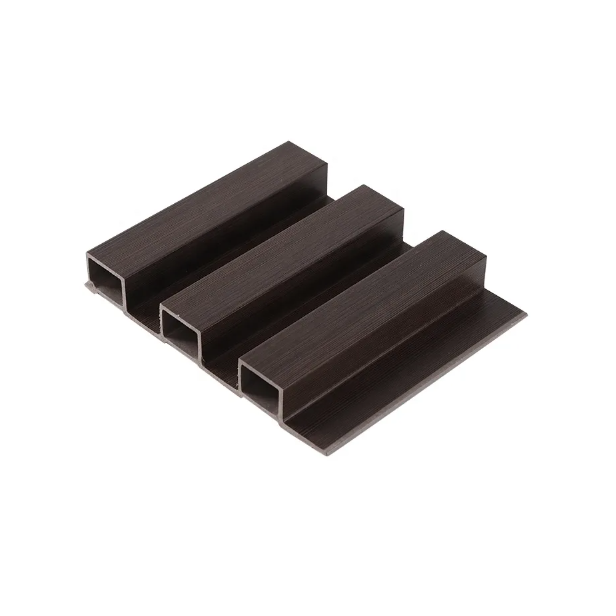
We sent David cut samples of our LT-WPC-WP165 co-extruded cladding in dark teak with synchronized wood-grain embossing. A week later, he messaged us saying the Wilsons had placed the sample on their outdoor dining table, lined it up next to their own teak furniture, and spent an entire day looking at it. They even poured half a glass of red wine over it to test stain resistance. They also placed it side by side with a leftover piece of fiber cement board and a scrap of aluminum composite panel from a neighbor's project.
Sarah's exact words, relayed through David: "Your texture is three-dimensional. When I run my fingernail across it, it follows the grain – not like that fake printed texture on cement boards. But can you guarantee it'll still look like this in five years?"
Facing this very practical question, we didn't send a lab report. Instead, we pulled a real installation video from our factory archive – the same product installed in 2019 on a island hotel in Zhoushan, China, shot in September 2024, after five typhoon seasons. The wall color had lightened slightly compared to new, but the wood-grain texture was intact. No warping, no mold spots. The grooves washed clean by rain even looked tidy.
Sarah's response: "Okay, I'm convinced. But only if it actually looks like this after 5 years." We all breathed a collective sigh of relief on our end.
A Small Incident During Installation
The Wilson house had 86 square meters of wall surface. David's crew planned to finish in five days. Here's the actual timeline:
| Day | Work Content | Time / Notes |
| Day 1 | Remove damaged pine cladding, inspect wall moisture barrier, repair furring strips | Completed as planned |
| Days 2-3 | Install vertical furring strips for leveling, lay insect mesh and bottom starter profiles, begin panel installation | On schedule – one person can install about 18㎡ per day |
| Day 4 | Panel installation nearly complete, install inside/outside corner trims | One panel misaligned due to temperature difference; 2 minutes with a hairdryer fixed it |
| Day 5 | Clean protective film, install top flashing, final walkthrough | Passed – Sarah blocked her painter on the spot |
The incident on the morning of Day 4 is worth telling separately. David called us, sounding a bit urgent: "One panel won't clip into the furring strips. If I force it, I might chip the edge."
We immediately started a video call and asked him to point his phone at the clip position. The issue was simple: the morning temperature difference by the sea caused the furring strips to expand slightly, misaligning the clip by less than 1 millimeter. The fix was simple: heat the back of the panel with a hairdryer for two minutes to restore the core layer's normal elasticity, and it clipped in smoothly. David later laughed: "You should put this in your installation manual. Call it the 'Sea Breeze Morning Special Procedure.'"
We honestly documented this minor incident in a supplementary technical note for our Australian clients. Because real job sites are like this – not something that can be fully captured by a line like "coefficient of thermal expansion ≤3.5×10⁻⁵/°C" on a spec sheet.
After completion, the Wilsons stood on their deck and looked at the wall for a long time. Sarah pulled out her phone and, right in front of David, deleted the painter's number she had saved for years: "I'm done with painting. Forever."
What Exactly Were the Specs of the Panels They Chose?
The model is our LT-WPC-WP165 co-extruded series. When communicating with David, I didn't bombard him with spreadsheets. Instead, I picked four points most relevant to his project and explained them in plain language:
Water absorption: below 0.8%. Seawater splashes won't penetrate the board, eliminating the breeding ground for mold and rot. Solid wood is typically 10%-20%, and fiber cement board's absorption spikes after coating failure – it's a different league.
Surface layer thickness: ASA co-extruded layer no less than 0.5mm. This outer protective skin is more weather-resistant than many automotive exterior parts. Aluminum composite panels typically have only a 0.02-0.03mm fluorocarbon coating – an order of magnitude thinner, with incomparable impact resistance.
Salt spray test: color difference of only 2.1 after 2000 hours of neutral salt spray. Even the harshest salt spray on the Mornington Peninsula won't reach that level of continuous exposure – a huge safety margin.
Linear coefficient of thermal expansion: ≤3.5×10⁻⁵/°C. This is why expansion gaps are needed, and why the "morning clip issue" happened. Aluminum composite panels have a lower thermal expansion coefficient (about 2.4×10⁻⁵), but they are installed with large-area edge locking. If not handled properly, summer sun exposure can cause bulging – that "wavy wall" effect is not uncommon in Australian coastal communities.
Full specifications are as follows:
| Parameter | Value | Plain English Translation |
| Cross-section dimensions | 165mm × 21mm | Width-to-thickness ratio suitable for cladding, visually close to traditional timber proportions |
| Unit weight | Approx. 2.9 kg/m | Lightweight, friendly to furring strip load |
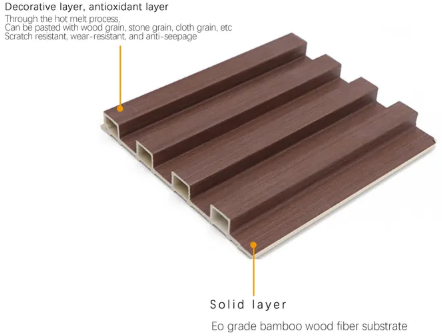
| Core material | 60% wood fiber + 35% HDPE + 5% additives | Recycled plastic + wood fiber, no preservative chemicals |
| Co-extruded surface | ASA alloy, thickness ≥0.5mm | Surface is extremely UV and corrosion resistant; impacts won't easily reach the core |
| 24h water absorption | ≤0.8% | Almost no water absorption after a day of soaking |
| Bending strength | ≥28 MPa | Strong enough to withstand wind pressure; won't break if leaned on |
| Xenon lamp aging 2000h color difference | ΔE<5 | Color change barely visible to the naked eye after years of sun exposure |
| Flame retardancy | B1 grade, self-extinguishing | Cigarette butts and barbecue sparks won't ignite the wall |
| Factory warranty | 25 years (non-load-bearing walls) | Longer than most home loans |
Four Exterior Wall Options – A Total Cost Breakdown
David later told me that the Wilsons' final decision wasn't because of any single impressive parameter. It was because they laid out the whole-life costs of all four options on the table and did the math. Here's that comparison table for other homeowners in a similar situation:
| Comparison | Haining Longtime WPC Co-extruded Cladding | Treated Timber (Pine/Garapa) | Aluminum Composite Panel (Wood-grain Transfer) | Fiber Cement Board (Coated) |
| Weather resistance | Excellent, 2000h salt spray ΔE<2.1, no mold or rot | Needs repainting every 2-3 years, otherwise cracks and blackens | Coating powders in 5 years, prone to blistering in salt spray | Coating ages in 5-8 years, absorbs water and softens after damage |
| Texture | Synchronized embossed 3D wood grain, warm touch, textured feel | Natural wood grain – the most beautiful, but requires maintenance | Cold metallic feel, printed wood grain looks fake | Blurred embossed texture, cold and hard feel, hollow sound |
| Water absorption | <0.8% | 10%-20% | Non-absorbent (but edge seepage corrodes aluminum core) | Spikes sharply when coating fails |
| Maintenance cost (20 years) | Almost zero – just rinse with water | Approx. 4,000-6,000 AUD/year for repainting | No repainting, but dents require full panel replacement | High-pressure wash + recoating every 5-8 years, costly |
| Installation method | Hidden clips, ~18㎡/day, individual panel replaceable | Exposed or hidden nails + adhesive, removal damages boards | Large-area edge locking, difficult to remove | Nailed or hung, heavy panels, lots of dust |
| 20-year total cost | Medium-high initial + zero maintenance = Best value | High initial + ongoing maintenance = Highest cost | Low initial + premature replacement = Hidden high cost | Medium initial + periodic recoating = Hidden high cost |
| Best for | Owners who don't want to climb ladders, want wood texture, and do the math | Owners willing to maintain regularly and pursue ultimate natural beauty | Budget-first commercial projects with low texture requirements | Projects requiring fire safety and accepting regular repainting |
David's exact words: "This stuff is made for lazy people. Lazy people are willing to pay a bit more upfront, in exchange for decades of doing nothing. The Wilsons are exactly that kind of 'high-end lazy' – it's not that they can't afford maintenance, it's that they think wasting weekends waiting for painters is simply not worth it."
Sarah Sent Us a Photo Later
In March this year, as autumn arrived in the southern hemisphere, Sarah sent us a photo of the whole family standing in front of the wall. Everyone was in short sleeves, and the wall was bathed in warm teak tones from the setting sun. She added a caption: "Still looks like the day you installed it. No regrets."
For those of us in the cladding business, receiving a photo like this feels better than getting the final payment.
It also confirmed one thing for us: in extreme environments like coastlines with high UV exposure, the real advantage of WPC cladding is not just the "eco-friendly concept." It's that it actually brings down the "long-term cost of ownership" while making the wall look warm and textured – unlike some materials that start aging the moment they're installed.
If You're Also Tired of Wall Maintenance, Here's How to Find Us
We don't rely on sales pitches. We recommend getting samples to see, touch, soak, and test yourself. That's how the Wilsons were convinced. If you have samples of aluminum composite panels, fiber cement boards, or other materials, place them side by side – the three-dimensional texture, the temperature in your hand, the way water beads on the surface – these details tell you more than any brochure ever could.
Haining Longtime Industry Co., Ltd. has been manufacturing WPC wall panels for over 15 years, exporting to more than 50 countries worldwide, including the United States, Australia, Canada, the United Kingdom, and beyond. Our factory is located in Haining City, Zhejiang Province, China, with five large-scale production bases ensuring consistent quality and reliable supply.
Tell us where your project is, how far from the sea, and what color and texture you're looking for. We'll match the right specifications based on your actual situation – not just throw a generic model at you.
For samples, color swatches, or installation drawings of the same cladding, email our export team directly with "Coastal Cladding Inquiry" in the subject line. We'll reply with specific selection recommendations within 24 hours.
Or visit our website at http://www.ltpvcfactory.com to submit your project information online.
A wall you don't have to worry about can truly change how a family defines coastal living. That's the Wilsons' story – and it could become yours.
For samples, quotes or technical consultation, please contact:
Official Website: http://www.ltpvcfactory.com
WhatsApp: +86 17757302351
Email: [email protected]
Sample Policy: Free samples and brochures are provided, with freight collect.