

 English
 Español
It all started with an email last September.
Our (Haining Longtime Industry Co., Ltd.) export team received an inquiry from Philippe, a French architect. The subject line was restrained, but the content was direct: "Restoration project – need stone, cannot use stone." He attached more than twenty photos: an 18th-century stone farmhouse in Provence, its exterior walls made of local limestone that, after over two centuries of sun, rain, and freeze-thaw cycles, had extensively weathered and flaked away. In several corners, the stone had even turned to powder – you could rub it with your fingers and it would crumble. To make things worse, the house sat on a steep slope in the Luberon mountains where even a tractor couldn't get in.
Philippe wrote in the email: "The owners are a Parisian couple who bought this old house as a holiday home. They want to restore the original stone facade appearance, but real stone is too heavy – the transport costs more than the stone itself. And the old wall foundations can't support another layer of real stone. I need something that looks like Luberon limestone but can be carried by one person."
After reading the email, I knew exactly what Philippe was up against. In Provence, restoration of historic stone houses faces strict planning restrictions – the exterior must maintain the local stone character, but quarrying, transport, and installation of real stone are prohibitively expensive. Philippe later told me that he had drawn up a simple table for the owners:
| Material Option | The Owners' Concern | Philippe's Field Experience |
| Local limestone (real stone) | Transport costs more than the stone itself | 25-30 kg/m², impossible to install on hillside, old walls can't support it |
| Cultured stone (cement-based) | Too uniform, clearly factory-made | Repetitive texture, color too uniform – doesn't look natural, heritage authority won't approve |
| Stone-look coating (textured paint) | Looks like stone from afar, like skin disease up close | Coating cracks within years, repairs look like patches |
| PU stone (polyurethane imitation stone) | Sounds like plastic, worried about texture | Philippe had seen it at a trade show in Paris but never used it in Provence |
In other words, before contacting us, the owners and Philippe had already looked into every possible option. The conclusion was consistent: either it's too heavy to install, or it's too fake to pass approval, or both. Philippe's email carried a sense of "one last decision to make."
Samples, Doubts, and a Video
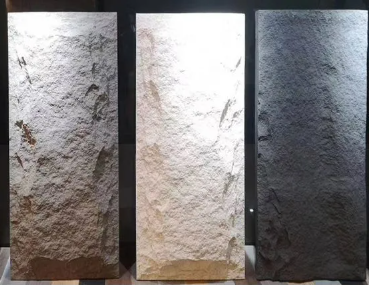
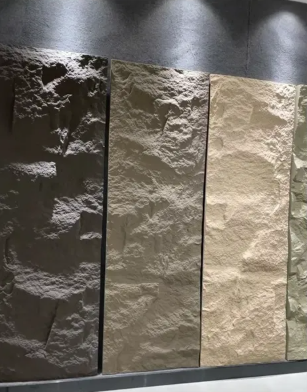
We sent Philippe samples of our LT-PU-Stone Provence limestone series – beige with natural holes and weathering marks, size 600×1200mm. Two weeks later, he messaged us saying the owners had flown in from Paris to inspect the roof work and placed the samples next to the old stone wall, comparing them side by side for a full day. They even scratched the surface with keys to test hardness.
Jean-Paul's exact words, relayed through Philippe: "The holes and weathering marks look almost identical to the old wall. The color gradient on the cross-section goes from surface to core, not just a painted layer. But it's not real stone after all – how do you guarantee it won't crack in ten years?"
Facing this practical question, we didn't send a lab report. Instead, we pulled a real installation video from our factory archive – the same series of PU stone installed in 2019 in a medieval town in Tuscany, Italy, shot in June 2025, six years after installation. The wall had endured six Italian winters of freeze-thaw cycles. The color had mellowed slightly compared to new, but the stone texture was intact – no cracking, no peeling, and the joints remained solid.
Jean-Paul's response: "If it survives Tuscany winters, it survives Provence." We all breathed a sigh of relief on our end.
An Incident That Surprised Philippe During Installation
The old house had 72 square meters of exterior wall requiring restoration, including the main facade and some local patching. Philippe's crew planned to finish in five days. Here's the actual timeline:
| Day | Work Content | Time / Notes |
| Day 1 | Clean weathered old stone wall, repair substrate, apply waterproofing | Completed as planned |
| Day 2 | Layout marking on leveled wall, begin PU stone installation | Ahead of schedule |
| Day 3 | Continue installation, handle window openings and corners | All smooth |
| Day 4 | Installation completed, install edge trims | One day ahead of schedule |
| Day 5 | Grouting, surface cleaning, final walkthrough | Passed – local stone mason came to watch |
Philippe called us on the evening of Day 3, clearly surprised: "This stuff goes up way too fast. My guys expected to level each piece one by one like real stone and wait for cement to dry. Instead, just apply structural adhesive, press it onto the wall, and it's done. One person installed nearly 20 square meters in a day."
PU stone installation is indeed simple. No cladding system, no welded framework, no waiting for cement mortar to dry. Apply structural adhesive in dots on the back of the PU stone on a flat substrate, and press it onto the wall. One person can handle the entire job. Where natural stone typically takes 7-10 working days, a PU stone project usually takes just 3-4 days.
What surprised Philippe even more was the cutting. "You can cut it with an ordinary handsaw – clean edges, no need for water jets. And almost no dust – which is critical when working inside an old house."
After completion, a local stone mason who had been working in the trade for forty years drove past, stopped his car, and studied the wall for a long time. He asked Philippe: "Which quarry did this stone come from? The color and texture are identical to our local limestone, but I've never seen this size format." Philippe smiled and replied: "Not a quarry. It's from a Chinese factory. Would you like a sample to take a look?"
What Exactly Were the Specs of the PU Stone They Chose?
- The model is our LT-PU-Stone Provence limestone series. When communicating with Philippe, I picked four points most relevant to his project:
- Weight: only 3-5 kg per square meter.Local limestone weighs 25-30 kg per square meter – PU stone is one-tenth to one-sixth the weight. The old wall foundations couldn't support another layer of real stone, but PU stone had no such issue.
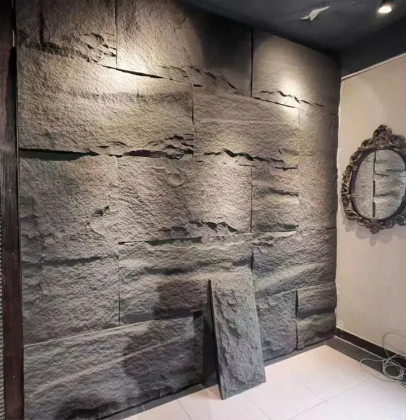
- Texture source: molded from real stone + hand-refined molds.Our molds are taken directly from local limestone. Every piece of PU stone replicates the texture of real stone – natural holes, weathering marks, and irregular edges. Not a printed image – it's three-dimensional. To match the distinctive character of Provence limestone, we also hand-refined the molds to simulate the natural spalling surface formed over two centuries of weathering.
- Weather resistance: 6 years of real-world validation + 2000-hour freeze-thaw testing.The Tuscany video we sent Philippe was the best proof. In addition, our outdoor PU stone has undergone cyclic freeze-thaw testing from -20°C to 70°C, with no cracking or peeling after 2000 cycles. Provençal winters, while cold, are nowhere near that severe.
- Fire + water resistance: B1 grade flame retardant + waterproof coating.PU stone is flame-retardant treated and self-extinguishing away from fire. The surface has a waterproof coating – non-absorbent, non-molding, no efflorescence. The "white blooming" problem that plagues natural limestone is completely absent on PU stone.
Full specifications are as follows:
| Parameter | Value | Plain English Translation |
| Material | High-density polyurethane (PU) | Not foam, it's rigid polyurethane |
| Standard sizes | 600×1200mm / 600×600mm | Large panels, fewer joints |
| Thickness | 20-50mm (varies by stone type) | Visual thickness close to real stone, only 1/10 the weight |
| Unit weight | Approx. 3-5 kg/m² | Easy for one person to carry |
| Texture source | Molded from real stone + hand-refined | Every texture comes from real stone |
| Installation method | Structural adhesive bonding | No cement, no cladding system, no framework |
| 24h water absorption | ≤0.5% | Non-absorbent, no efflorescence, no whitening |
| Freeze-thaw cycles | 2000 cycles (-20°C~70°C) | Far more severe than Provençal winters |
| Fire rating | B1 grade, self-extinguishing | Cigarette butts and sparks won't ignite it |
| UV resistance (outdoor grade) | UV coating + weather-resistant treatment | No significant fading under sun exposure |
| Factory warranty | 10 years (non-load-bearing walls) | — |
Three Options, One Table – The Total Cost Breakdown
Philippe later told me that the owners' final decision wasn't because of any single impressive feature. It was because they laid out the total cost of all three options on the table and did the math:
|
Comparison |
Haining Longtime PU Stone | Local Limestone (Real Stone) | Stone-Look Coating (Textured Paint) |
| Weight (kg/m²) | 3-5 | 25-30 | <1 (coating) |
| Texture realism | Molded from real stone, 3D texture | Natural, unique | Flat coating, no three-dimensionality |
| Tactile feel | Warm, sandy texture | Cold and hard | Smooth or rough coating |
| Installation method | Adhesive bonding, one-person operation | Cladding/wet set, requires machinery | Spray application, requires special equipment |
| Construction time (72m²) | 3-4 days | 10-14 days | 5-7 days |
| Planning approval | High visual match, easy approval | Requires quarry permits, complex approval | Appearance controversial, often rejected |
| 20-year maintenance cost | Almost zero | Requires periodic sealing, repointing | Requires recoating every 5-8 years |
| Best for | Owners who want stone texture but can't use real stone | Owners with ample budget seeking ultimate quality | Projects on a budget and accepting periodic maintenance |
Philippe's exact words: "PU stone achieves 'looks like stone' and 'actually installable' at the same time. That's exactly what Jean-Paul and his wife wanted – something that looks like every other old house on this street, without worrying about the stone weathering away again in a hundred years."
Jean-Paul Sent a Message Later
In June this year, as summer arrived in Provence, Jean-Paul sent a photo – the new stone wall glowing warm beige in the sunset, a long table set in the courtyard, the family having dinner. He added a caption: "The stone mason from the village came by last week. He asked for your contact."
For those of us in building materials export, receiving a message like this feels better than getting an order.
It also confirmed one thing for us: in historic building restoration, hillside sites, and old wall structures where natural stone simply "can't be installed" or "can't be afforded," the real value of PU stone isn't that it's "cheap." It's that it turns "stone texture" from impossible into possible.
If You're Also Looking for Something That Looks Like Stone but Actually Installs
We don't rely on sales pitches. We recommend getting samples to see, touch, and tap with a hammer yourself. That's how Jean-Paul was convinced.
Haining Longtime Industry Co., Ltd. has been manufacturing PU stone and related decorative materials for over 10 years, exporting to more than 40 countries worldwide, including France, Italy, the United Kingdom, the United States, Australia, and beyond. Our factory is located in Haining City, Zhejiang Province, China.
Tell us where your project is, whether it's a historic restoration or new construction, and what stone texture and color you're looking for. We'll match the right style based on your actual situation.
- For PU stone samples, color swatches, or installation drawings, email our export team directly with "Stone Cladding Inquiry" in the subject line. We'll reply with specific selection recommendations within 24 hours.
- Or visit our website at http://www.ltpvcfactory.comto submit your project information online.
For samples, quotes or technical consultation, please contact:
Official Website: http://www.ltpvcfactory.com
WhatsApp: +86 17757302351
Email: [email protected]
Sample Policy: Free samples and brochures are provided, with freight collect.