

 English
 Español
Don't Just Listen to Sales Talk: How to Read PS Wall Panel Fire, Waterproof, CE, and Environmental Certificates
When you buy PS wall panels, salespeople might say a lot: "our environmental standards are high", "waterproof is no problem", "fire resistant"... but words are cheap. The real proof is in the test reports and certificates.
But most people don’t read them – because they look complicated. Today we’ll focus on the four most common certificates – Fire, Waterproof, CE, and Environmental – and show you what to look for, what the numbers mean, and what counts as good. Next time you buy PS panels, just ask for these four documents. You’ll know exactly what you’re getting.
1. Fire Certificate: Look for B1 Grade
For interior wall panels, fire rating matters. In China, the standard is GB 8624, with grades B1 (difficult to ignite), B2 (normally flammable), and B3 (easily flammable).
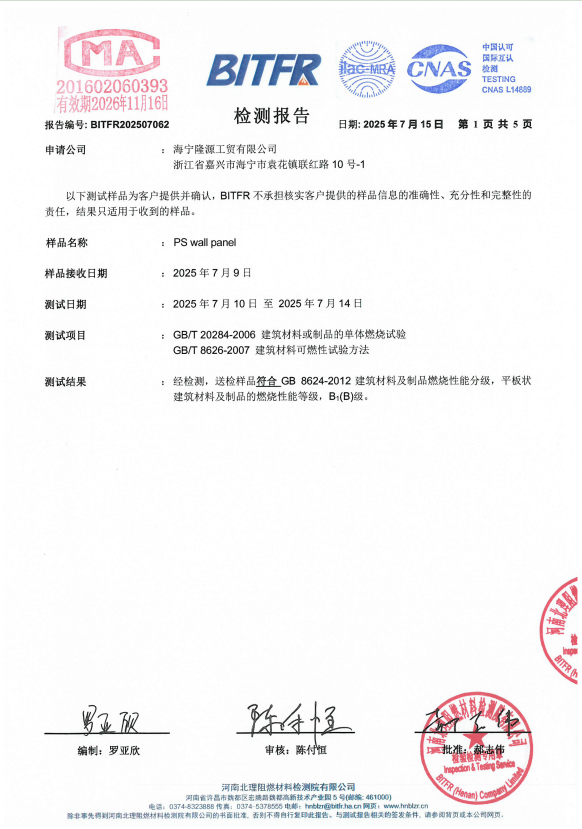
What to look for on the certificate
Grade: At least B2, but B1 is best.
Details: A B1 certificate will state "combustion performance meets B1 grade" and include data on flame spread length, smoke toxicity, and smoke production.
How to interpret the numbers
| Grade | Meaning | Standard | Buy or not |
| B1 | Difficult to ignite | Self-extinguishing, flame does not spread | First choice |
| B2 | Normally flammable | Burns, but does not spread easily | Acceptable but not ideal |
| B3 | Easily flammable | High fire risk | Do not use |
What to ask the seller
"Is your PS wall panel fire rating B1 or B2? Can you send me the fire test report according to GB 8624?"
If the seller hesitates or just says "fire-resistant" without a grade – find another supplier.
2. Waterproof Certificate: Lower Water Absorption = Better
A key selling point of PS panels is waterproofing and moisture resistance. The most direct indicator is water absorption rate, usually tested under GB/T 24137 or similar standards.
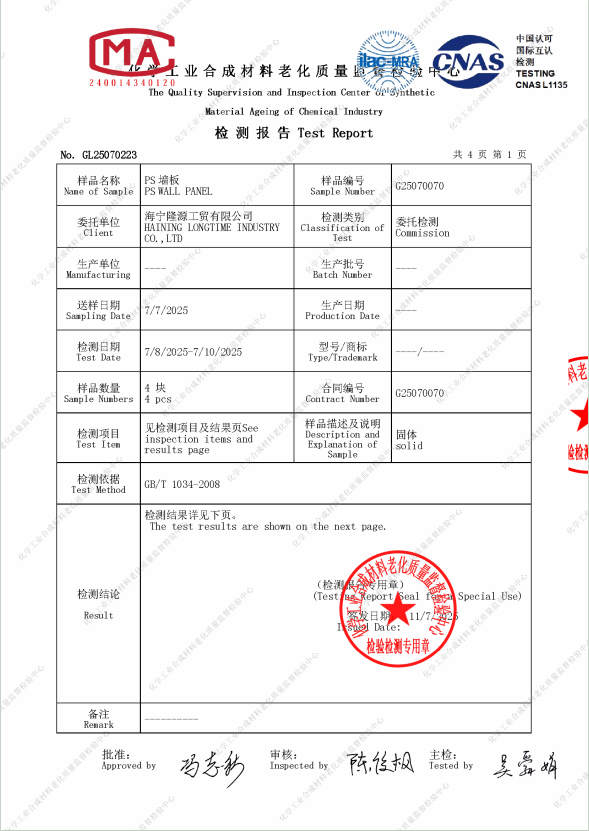
What to look for on the certificate
Water absorption rate (in %)
Test method: Typically "24hour immersion test"
How to interpret the numbers
| Water absorption | Performance | Suitable? |
| ≤0.5% | Almost no absorption, no swelling or mold even after long immersion | Excellent |
| 0.5% – 1.0% | Slight absorption, perfectly fine for dry areas | Acceptable |
| >1.0% | Noticeable absorption – may deform in humid environments | Not recommended for bathrooms |
Good PS panels usually have water absorption ≤0.5%. Some high quality products go as low as 0.1% – even better.
What to ask the seller
"What is the water absorption rate on your waterproof certificate? Do you have a test report according to GB/T 24137?"
You can also ask: "Do you have swelling rate data after water immersion?" Lower swelling means safer for wet areas.
3. CE Certificate: A Passport to European Markets – Also a Trust Signal for Domestic Buyers
CE certification is mandatory for many products sold in the EU. Even if you only sell locally, having CE means the product meets EU standards, which often indicates higher quality.
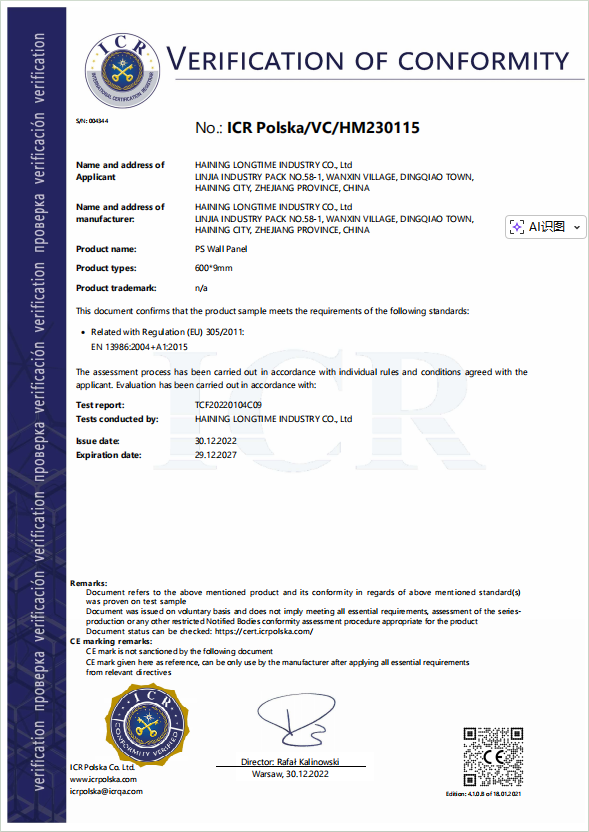
What to look for on a CE certificate
For wall panels, CE covers at least:
- Reaction to fire(EN 13501-1)
- Formaldehyde emission(EN 717-1 or EN 16516)
- Restricted substances(REACH)
How to judge
- CE certificate + detailed test data (e.g., formaldehyde ≤0.124mg/m³, meeting E1 grade) – excellent.
- CE certificate but no numbers – at least it passes basic safety.
- No CE certificate – doesn’t mean bad, but export-grade quality inspires more confidence.
What to ask the seller
"Do you have a CE certificate for your PS panels? Can you send me the CE test report so I can see the formaldehyde and fire data?"
4. Environmental Certificate: “No Formaldehyde” Isn’t Just a Claim – Check the Number
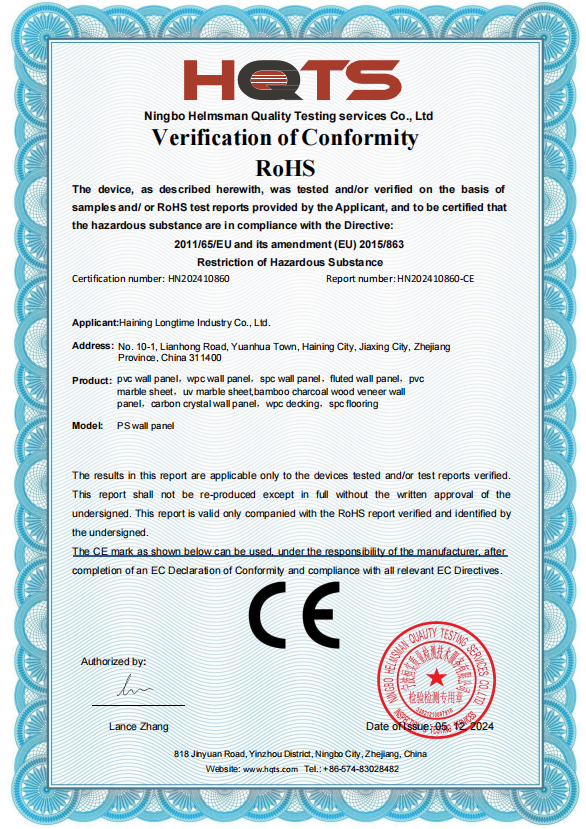
Environmental certificates might be the China Environmental Label (Ten Circles) , ISO 14001, or simply a third-party test report showing formaldehyde emission and TVOC. The most common domestic standard is GB 18580.
What to look for on the report
Formaldehyde emission (mg/m³ by chamber method, or mg/L by desiccator method)
TVOC emission – total volatile organic compounds
How to interpret the numbers
| Parameter | GB 18580 limit | Good PS panel should be | Trustworthy? |
| Formaldehyde emission | ≤0.124 mg/m³ | Not detected or ≤0.02 mg/m³ | Excellent |
| TVOC (reference) | No mandatory limit | ≤0.5 mg/m³ | Low emission |
“Not detected” is best – it means the level is below the instrument’s detection limit, essentially zero.
If the report only says “qualified” without giving a number – that’s weak. Always ask for the actual value.
What to ask the seller
"Do you have a formaldehyde test report according to GB 18580? I want to see the actual number, not just the word 'qualified'."
Summary: Four Questions to Ask Before You Buy
| Certificate | Key thing to check | Good standard | What to ask |
| Fire (GB 8624) | Combustion grade | B1 (difficult to ignite) | Send me the B1 fire test report |
| Waterproof | Water absorption (%) | ≤0.5% | What’s the water absorption number? |
| CE | Certificate + test values | Has CE + good formaldehyde/fire data | Send the CE test report |
| Environmental (GB 18580) | Formaldehyde value | Not detected or ≤0.02 mg/m³ | Send the formaldehyde report with the actual number |
Final Words: You Don’t Need to Be an Expert – Just Ask Four Questions
You don’t have to read every page of every report. Just remember these four questions:
- Fire– "Let me see the B1 report."
- Waterproof– "What’s the water absorption rate? Needs to be ≤0.5%."
- CE– "Do you have a CE certificate and test data?"
- Environment– "Formaldehyde report with the actual number, please."
Any salesperson who hears these four questions will know you’re serious. And those who can’t produce the reports will filter themselves out.