

 English
 Español
A Must-Read for Global Buyers: PS Wall Panels vs. PVC Wall Panels – A Full 10-Dimension Comparison. Which One Is the Real Hard Currency?
You are in foreign trade. Your customers come from all over the world: the Middle East, Southeast Asia, Africa, South America, Europe. What do they ask most often? Not “how much”, but “what certificates do you have”. No matter the market, buyers are getting smarter. They don’t care about stories – they want test reports and certifications.Today we put PS wall panels and PVC wall panels head-to-head across 10 dimensions, backed by the four certificates you already have: Fire, Waterproof, CE, and Environmental. After reading this, you’ll know how to explain to your customers why your product costs a bit more than cheap PVC – but is well worth it.
1. 10 Dimensions – One Table Tells the Story
| Dimension | PS Wall Panel | PVC Wall Panel (Low-Price Competitor) |
| 1. Fire rating | B1 (difficult to ignite, self-extinguishing) | B2/B3 (burns, keeps burning, black smoke) |
| 2. Water absorption | ≤0.5% (almost no absorption, no mold) | 1%-2% (absorbs water, swells, warps, molds) |
| 3. CE certification | Yes (meets EN standards, E1 for formaldehyde) | Most have none, or fake certificates |
| 4. Formaldehyde emission | Not detected (below detection limit) | Close to limit or exceeds; strong smell from recycled material |
| 5. Surface scratch resistance | HB-F (key leaves almost no mark) | ≤2B (fingernail leaves a white scratch) |
| 6. Thermal expansion stability | Low coefficient (stable from -20°C to 60°C) | High expansion – deforms in heat, brittle in cold |
| 7. Impact resistance | ≥10 kJ/m² (stands up to hits) | 3-5 kJ/m² (cracks easily) |
| 8. UV yellowing resistance | ΔE < 2 (no yellowing indoors for 5 years) | ΔE > 4 (obviously yellow in 2-3 years) |
| 9. Service life | 10-15 years | 3-5 years (brittle, faded, deformed) |
| 10. Target customers | Wholesalers, contractors, hotel/hospital projects | Temporary structures, very low-budget markets |
Conclusion: PVC is 30-50% cheaper – but the cheapness hides poor fire safety, poor environmental performance, and short life. PS panels cost a little more per square meter, but you get safety, quality, and peace of mind with no after sales headaches for a decade.
2. Let the Certificates Speak – Four Hard Currencies, None Can Be Missed
2.1 Fire Certificate: B1 is the Minimum
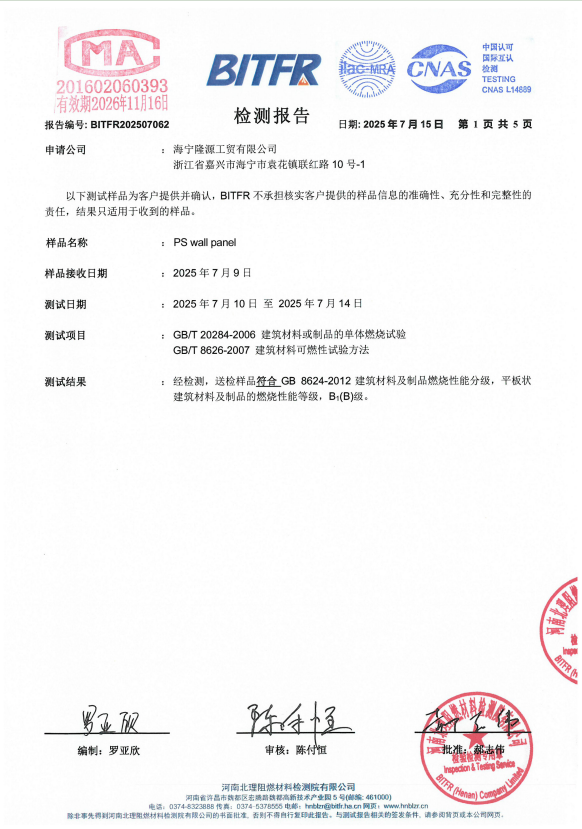
- PS wall panel: B1 grade. A lighter flame will blacken the surface, but the fire self-extinguishes 2-3 seconds after the flame is removed. No spreading, no dripping, low smoke toxicity.
- PVC wall panel: B2 or B3. It keeps burning after the flame is removed, producing thick black smoke containing hydrogen chloride (toxic).
Talking point to customers: “We can send you our B1 report. Your customer will pass fire inspection the first time. With PVC, if a fire happens, the insurance company may refuse to pay – and your customer could even face legal liability.”
2.2 Waterproof Certificate: Water Absorption ≤0.5% – Only Then Can You Call It Waterproof
- PS wall panel: After 24-hour immersion, water absorption ≤0.5%. No swelling, no mold. Perfect for humid tropical countries, basements, and bathroom dry zones.
- PVC wall panel: Water absorption 1-2%. In long-term humid environments, it warps and grows mold on the back.
Talking point: “Customers in Southeast Asia are most afraid of mold. Our water absorption is below 0.5% – it survives even soaking in water. PVC? Deformed and smelly in three years.”
2.3 CE Certificate: Not Just for Europe
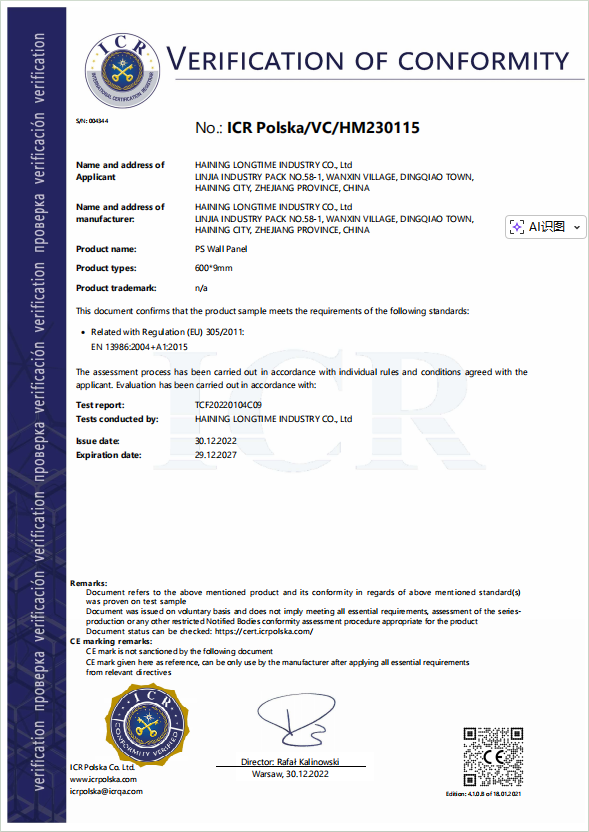
CE certification is not only required for Europe. Many government projects and large buyers in the Middle East, Africa, and Southeast Asia also recognize it, because CE proves the product meets international safety standards.
- PS wall panel: CE certificate + specific test data (formaldehyde ≤0.124 mg/m³, meets E1 grade).
- PVC wall panel: Most have no CE. Even if they claim to, the certificates are often fake.
Talking point: “Our CE report has a traceable number. PVC without CE can even be held up at customs. Are you willing to take that risk?”
2.4 Environmental Certificate – “Not Detected” is True Eco-Friendly
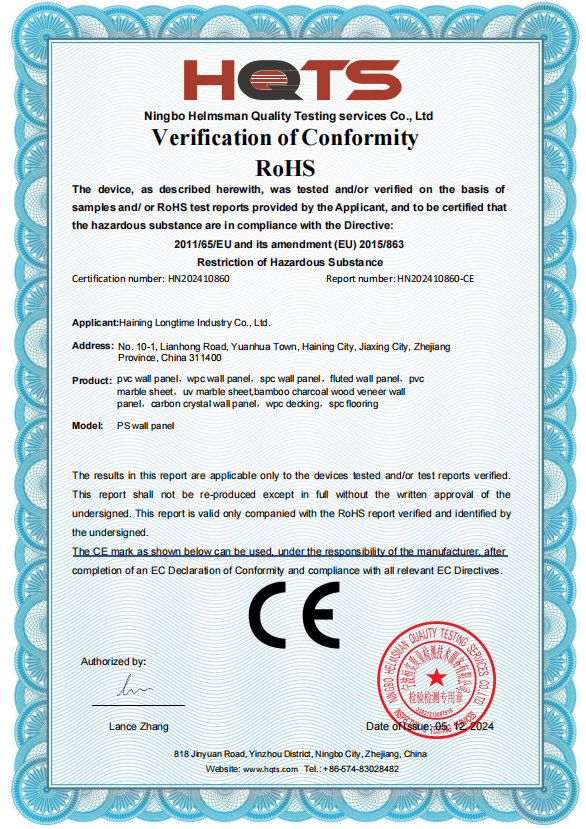
- PS wall panel: Formaldehyde emission “not detected” (below the instrument’s detection limit). No irritation, no plastic smell. Safe for kindergartens and hospitals.
- PVC wall panel: Often close to the limit or uses recycled material + lead-based stabilizers (contains heavy metals).
Talking point: “Kindergarten and hospital projects specify formaldehyde-free materials. We have a ‘not detected’ report. Would you dare use cheap PVC in a children’s room?”
3. More Hard Comparisons – Get Down to the Details
3.1 Surface Scratch Resistance
- PS: Pencil hardness HB-F. Scrape hard with a key – wipe with a finger and the mark almost disappears. Everyday use (pets, zippers, toys) is no problem.
- PVC: Pencil hardness ≤2B. A fingernail leaves a white scratch. After two years in a rental, the walls look terrible.
3.2 Thermal Expansion and Contraction
- PS: Thermal expansion coefficient 6-8×10⁻⁵/°C. Works on heated floors, under the Middle Eastern sun, or with Nordic radiators – dimensions stay stable all year.
- PVC: Expansion coefficient about 15×10⁻⁵/°C – double that of PS. Joints open in summer, and cold shrinks cause cracking in winter.
3.3 Impact Resistance
- PS: Drop ball impact strength ≥10 kJ/m². Even if a hand truck hits the wall on a construction site, the panel survives.
- PVC: Brittle – cracks easily from a heavy blow.
3.4 UV / Yellowing Resistance
- PS: ΔE < 2 (indoor, 5 years). Light-colored panels on a balcony – no yellowing for 3 years.
- PVC: ΔE > 4 (yellow after two years). Cannot be used near windows.
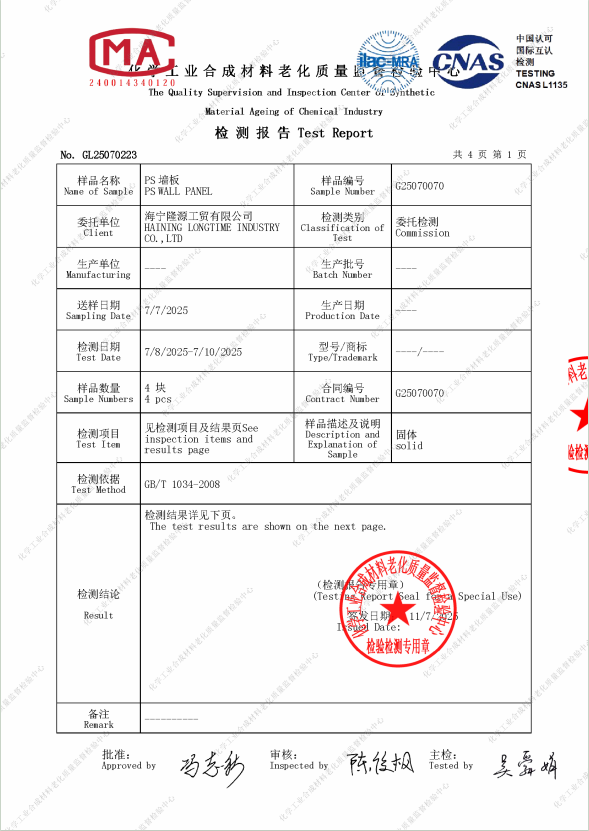
4.Product Qualification(产品认证)
5.5 Most Common Questions from Foreign Trade Customers (Q&A)
Q1: My customer only asks for price, not certificates. What should I do?
A: That means the customer is a low-budget buyer and not your target. You need to educate him: cheap PVC will yellow and become brittle in three years, and then the customer will blame you. PS panels cost a little more, but they need no after-sales work for a decade. Send him this article and let him decide.
Q2: The customer wants EN standards. Do we have them?
A: CE certification itself is based on EN standards (e.g., EN 13501-1 for fire, EN 717-1 for formaldehyde). If your CE report already shows test data according to EN standards, show it directly. If not, you can get additional EN-standard tests done – the cost is not high.
Q3: Customers come from hot countries (Middle East, Africa). Will PS panels deform?
A: PS has a thermal expansion coefficient 40% lower than PVC. It is dimensionally stable from -20°C to 60°C. Indoor temperatures in the Middle East never exceed 50°C even in summer. You can use it with confidence. We can also provide 70°C heat-aging test data.
Q4: Customers come from humid countries (Southeast Asia, South America). Do PS panels get moldy?
A: PS itself does not support mold growth. With water absorption ≤0.5%, no moisture penetrates the substrate. As long as the joints are properly sealed during installation, there will be no mold in 50 years. PVC absorbs moisture internally, which becomes a breeding ground for mold.
Q5: I am a wholesaler. My customer wants OEM – can the certificates be changed to his brand?
A: Fire, waterproof, and CE certificates carry the product model and factory information. If the customer needs his brand on the certificate, you can either create a derived report based on your original one, or the customer can have his own sample tested. You can provide the original reports and samples to support him.